








- [Review]
- Design and Application of Drug Carrier Based on Drug Delivery System for Effective Disease Therapy
Yoo-Sung Choi and Gyeong-Won Jeong†

Department of Bioenvironmental & Chemical Engineering, Chosun College of Science and Technology, Gwangju 61453, Korea
- 효과적인 질병 치료를 위한 약물전달시스템 기반 약물 전달체 설계 및 응용
최유성 · 정경원†
조선이공대학교 생명환경화공과
Reproduction, stored in a retrieval system, or transmitted in any form of any part of this publication is permitted only by written permission from the Polymer Society of Korea.
Polymer-assisted drug delivery systems (DDS) are advancing therapeutics by offering precise spatial and temporal drug release. Unlike conventional formulations that produce fluctuating plasma levels and systemic side effects, polymeric DDS maintain steadier concentrations and improve pharmacokinetic and pharmacodynamic performance. Key developments include biodegradable polymers, hydrogels, and polymeric micelles for controlled and targeted delivery. “Smart” DDS that respond to pH, temperature, or enzyme activity, along with nanocarriers that accumulate in diseased tissues, are increasingly significant. Polymeric micelles are especially effective at solubilizing hydrophobic drugs and enabling sustained, site-specific delivery. Despite challenges in large-scale manufacturing, reproducibility, and in vivo stability, progress in polymer chemistry and AI-driven design is accelerating next-generation, multi-responsive DDS suited for personalized therapies.
고분자 기반 약물전달시스템(DDS)은 약물의 공간적·시간적 방출을 정밀하게 제어함으로써 현대 치료에 큰 변화를 가져오고 있다. 기존 제형이 혈중 농도 변화와 부작용을 초래하는 것과 달리, 고분자 DDS는 보다 안정적인 약물 농도를 유지하고 약동·약력학적 성능을 향상시킨다. 생분해성 고분자, 하이드로젤, 고분자 미셀 등은 조절·표적 전달 기술의 핵심 발전으로 주목받고 있다. 또한 pH, 온도, 효소 활성 등에 반응하는 ‘스마트’ DDS와 병변 조직에 선택적으로 축적되는 나노캐리어의 중요성도 커지고 있다. 특히 고분자 미셀은 난용성 약물의 용해도 향상과 특정 치료 부위 전달에 매우 효과적이다. 앞으로 대량 생산, 재현성, 체내 안정성 등의 한계가 남아 있지만, 고분자 화학과 AI 기반 설계의 발전으로 개인 맞춤형 치료에 적합한 차세대 다중 반응형 DDS 개발이 가속화될 것으로 사료된다.
The advancement of precision medicine has fueled the development of intelligent or stimuli-responsive drug delivery systems (IDDS). Unlike traditional systems that release drugs passively at a fixed rate, IDDS dynamically respond to physiological or external triggers pH, temperature, redox potential, light, or magnetic fields enabling on-demand drug release while minimizing off-target effects.
Keywords: drug delivery system, intelligent drug delivery system, targeted drug delivery, polymeric micelles, bio-materials.
This research was supported by the Regional Innovation System & Education (RISE) program through the (Gwangju RISE Center), funded by the Ministry of Education (MOE) and the (Gwangju Metropolitan City), Republic of Korea (2025-RISE-05-014).
The authors declare that there is no conflict of interest.
The evolution of drug delivery systems (DDS) has fundamentally transformed therapeutic science by shifting the focus from drug discovery alone to optimizing how, where, and when drugs exert their effects.1,2 Traditional administration routes, such as oral ingestion or intravenous injection, often produce fluctuating plasma drug levels, leading to reduced efficacy, increased toxicity, and decreased patient adherence.3 Controlled-release and targeted-delivery platforms were therefore developed to maintain optimal drug concentrations over extended periods while minimizing systemic exposure.4
The origins of controlled DDS can be traced to the groundbreaking work of Langer and Folkman in the 1970s, who demonstrated that biologically active macromolecules could be released steadily from biocompatible polymer matrices.4 This pivotal discovery enabled the sustained administration of proteins, peptides, and nucleic acids agents once considered unsuitable for controlled release.5 Since then, polymer science has provided essential tools for DDS design, offering tunable degradation rates, biocompatibility, and structural versatility. Biodegradable polymers such as poly(lactic acid) (PLA), poly(glycolic acid) (PGA), and their copolymers (PLGA) have become widely used due to their predictable degradation into non-toxic by-products.6-8 Hydrogels, three-dimensional hydrophilic polymer networks, have also drawn significant interest because of their ability to absorb water, mimic soft tissue, and regulate molecular diffusion, making them ideal candidates for localized and sustained drug release.9-12
The next frontier of DDS development involves intelligent or stimuli-responsive systems capable of adapting to physiological conditions. These systems respond to variations in pH, temperature, or enzyme concentration to achieve spatially and temporally controlled drug release.13 For example, pH-sensitive hydrogels can selectively release therapeutic agents in the acidic tumor microenvironment, while thermosensitive polymers form injectable gels that solidify in situ, enabling prolonged local release.14 Nanotechnology has further advanced the field by enabling the creation of specialized delivery vehicles such as liposomes, polymeric nanoparticles, and micelles that facilitate both passive and active targeting. Leveraging the enhanced permeability and retention (EPR) effect and ligand-mediated recognition, these nanocarriers significantly enhance drug localization.15-17 Polymeric micelles are especially advantageous because their amphiphilic architecture enables drug solubilization, stability enhancement, and immune evasion.
Overall, DDS have evolved from simple diffusion-based systems to multifunctional and adaptive nanoplatforms, marking a vital step toward precision medicine. Integration of polymer engineering, nanotechnology, and intelligent system design now enables patient-specific therapies based on biological context and therapeutic needs. In this study, we aim to examine DDS design methods and application technologies that can maximize therapeutic efficiency in line with advances in drug delivery systems.
Controlled drug delivery aims to regulate the spatial and temporal release of therapeutic molecules to maintain plasma concentration within a therapeutic window for extended periods.10 These systems operate through mechanisms such as diffusion, degradation, osmotic pressure, or polymer swelling. Early models suggested that macromolecules could not be continuously released from polymer matrices due to their large molecular weights.18 However, Langer and Folkman overturned this notion in 1976 by showing that macromolecules exceeding two million Daltons could be released continuously from biocompatible polymers.1 This discovery expanded the feasibility of polymer-based controlled release systems to a variety of biomolecules previously unsuitable for conventional formulations.12
Today, controlled DDS play a central role in managing chronic diseases. Biodegradable polymers such as PLGA or polycaprolactone (PCL) are widely used (Figure 1). These materials degrade gradually in vivo, releasing encapsulated drugs at predetermined rates, reducing dosing frequency, and improving patient adherence.5

|
Figure 1 Controlled DDS design based on (a) PLGA or (b) PCL biodegradable polymer. Reproduced with permission from Ref. 41, Cheng, J. et al., Biomaterials, 2007, 28. ©2010 Elsevier. Reproduced with permission from Ref. 42, P. Grossen, et al., J. Control. Release, 2017, 260. ©2010 Elsevier. |
The advancement of precision medicine has fueled the development of intelligent or stimuli-responsive IDDS. Unlike traditional systems that release drugs passively at a fixed rate, IDDS dynamically respond to physiological or external triggers pH, temperature, redox potential, light, or magnetic fields enabling on-demand drug release while minimizing off-target effects.
Principles and Mechanisms. Stimuli-responsive DDS are typically based on polymeric networks or hybrid nanocarriers that undergo reversible physicochemical transformations in response to well-defined stimuli. These transformations include changes in polymer chain conformation, crosslinking density, hydrophilicity, or chemical bond integrity, which collectively regulate drug encapsulation stability and release kinetics. Depending on the nature of the trigger, drug release may occur through enhanced diffusion, carrier disassembly, matrix erosion, or cleavage of covalent drug–polymer linkages. Stimuli are broadly classified into internal (endogenous) stimuli, such as pH, enzyme activity, redox potential, or metabolite concentration, and external (exogenous) stimuli, including temperature, light, magnetic fields, and ultrasound.
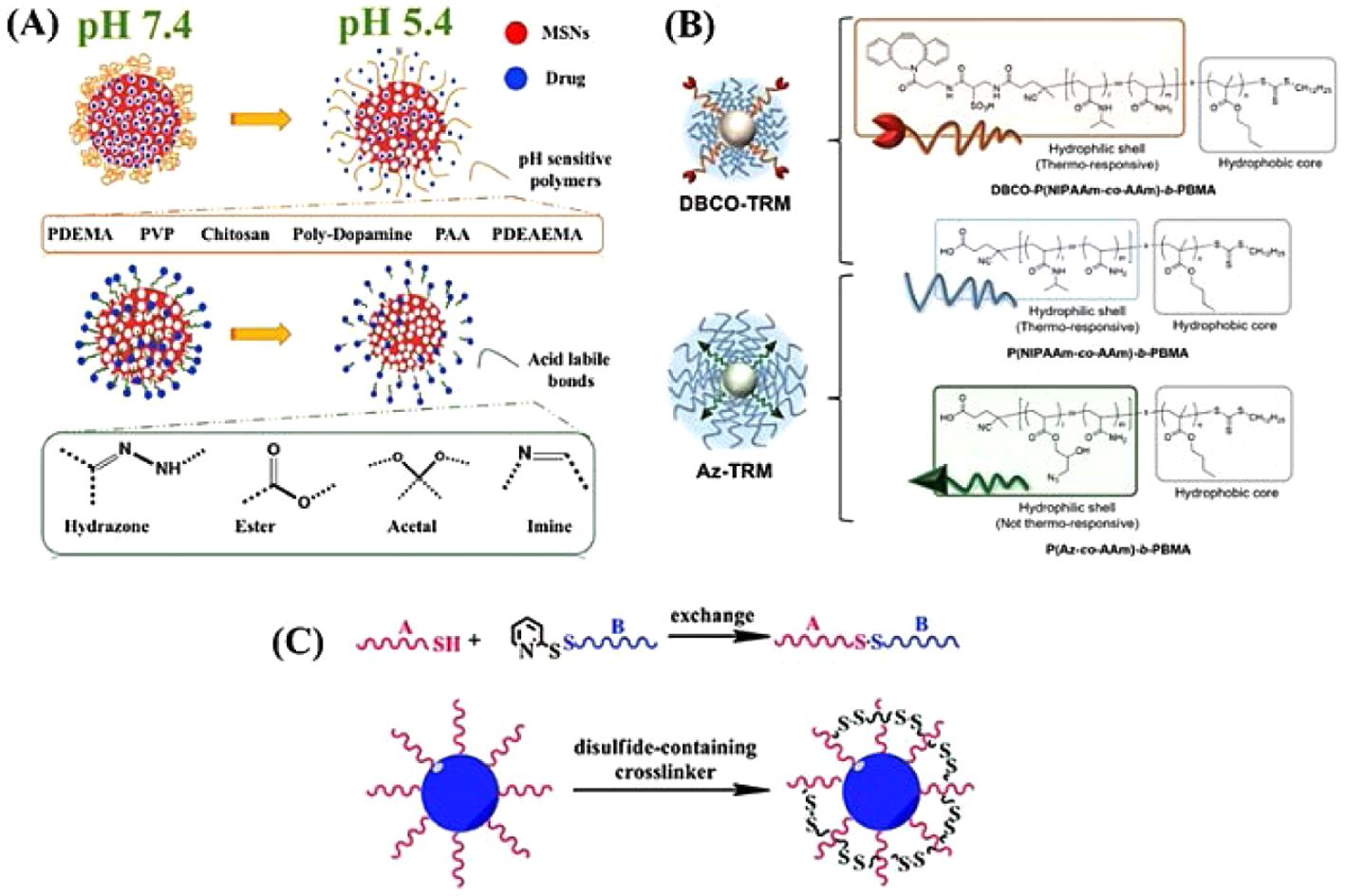
pH-responsive DDS exploit spatial variations in acidity across physiological and pathological environments.6,11 While blood and normal tissues maintain a near-neutral pH (~7.4), tumor extracellular matrices (pH ~6.5–6.8), inflamed tissues, and intracellular compartments such as endosomes and lysosomes (pH 4.5–6.0) are significantly more acidic (Figure 2(a)). Polymers bearing ionizable functional groups such as carboxylic acids in poly(acrylic acid), amine groups in chitosan, or tertiary amines in poly(β-amino ester) undergo protonation or deprotonation in response to pH changes. Protonation increases electrostatic repulsion between polymer chains, leading to network swelling, micelle destabilization, or pore expansion, which accelerates drug diffusion. In some systems, acidic pH induces cleavage of acid-labile bonds (e.g., hydrazone, acetal, or imine linkages), enabling selective drug release in tumor or intracellular environments while minimizing premature leakage in circulation.
Thermo-responsive systems rely on polymers that exhibit a critical phase transition at a specific temperature, most commonly a lower critical solution temperature (LCST) near physiological temperature (Figure 2(b)). Polymers such as poly(N-isopropylacrylamide) (PNIPAM) or PEG–PLGA undergo a coil-to-globule transition as temperature increases above the LCST. Below the LCST, hydrogen bonding between polymer chains and water dominates, resulting in a hydrated, soluble state.19,20 Above the LCST, hydrophobic interactions prevail, causing polymer chain collapse and gel formation or nanoparticle aggregation. Injectable thermo-responsive hydrogels exploit this behavior by remaining in a low-viscosity sol state at room temperature and rapidly forming a gel upon administration, creating an in situ drug depot that enables sustained and localized drug release.
Enzyme-responsive systems incorporate peptide sequences or ester bonds that are selectively cleaved by enzymes overexpressed in specific pathological environments, such as matrix metalloproteinases (MMPs) in tumors or esterases in inflamed tissues (Figure 2(c)). Enzymatic cleavage reduces crosslinking density or destabilizes the carrier architecture, leading to network degradation or enhanced permeability.21-23 In parallel, redox-responsive DDS exploit the large intracellular–extracellular redox gradient. High intracellular concentrations of glutathione (1–10 mM) reduce disulfide bonds within polymer backbones or crosslinkers, triggering carrier disassembly and rapid intracellular drug release, while remaining stable in the oxidative extracellular environment.
Externally triggered DDS provide spatiotemporal control over drug release through non-invasive external stimuli.24 Magnetic-responsive systems incorporate superparamagnetic iron oxide nanoparticles that generate localized heat under an alternating magnetic field, inducing thermal disruption of polymer matrices or phase transitions. Ultrasound-responsive carriers rely on acoustic cavitation or mechanical stress to enhance membrane permeability or disrupt carrier integrity. Light-responsive systems utilize photo-cleavable moieties (e.g., o-nitrobenzyl or coumarin groups) or photothermal agents, enabling precise control of drug release by regulating light wavelength, intensity, and exposure duration, thereby minimizing off-target effects.

|
Figure 2 Stimuli-responsive DDS design with various functional factor: (a) pH-responsive system; (b) Thermo-responsive system; (c) Enzyme/ redox-responsive system. Reproduced with permission from Ref. 45, Mazzotta, E. et al., Materials Today Bio, 2022, 17, ©2010 Elsevier. Reproduced with permission from Ref. 43, Yamada, S. et al., Commun. Chem., 2024, 7, © communications chemistry. Reproduced with permission from Ref. 44, Huo, M. et al., Polym. Chem., 2014, 5, ©2010 The Royal Society of Chemistry. |
Targeted DDS aim to deliver therapeutic agents specifically to diseased tissues while minimizing systemic exposure.25,26 This improves efficacy, reduces side effects, and enhances the therapeutic index.
Principles of Targeted Drug Delivery. Targeted drug delivery aims to selectively transport therapeutic agents to specific tissues or cells in order to enhance therapeutic efficacy while minimizing systemic side effects. Targeting strategies are generally classified into passive targeting and active targeting.
Passive targeting exploits the enhanced permeability and retention (EPR) effect, which arises from the pathological characteristics of tumor tissues.27 Tumor vasculature is typically immature and highly permeable, exhibiting large endothelial gaps, while lymphatic drainage is inefficient. These features allow nanoscale drug carriers to preferentially extravasate and accumulate within tumor tissues (Figure 3(a)). The extent of the EPR effect varies depending on tumor type, size, vascular density, and interstitial fluid pressure, which can significantly influence drug delivery efficiency.
Active targeting involves the functionalization of drug carrier surfaces with specific ligands, such as antibodies, peptides, carbohydrates, or small molecules, to facilitate selective binding to receptors overexpressed on target cells.28 Following ligand–receptor interaction, carriers are internalized via receptor-mediated endocytosis, thereby increasing cellular uptake and improving targeting specificity (Figure 3(b)). Compared with passive targeting, active targeting offers enhanced selectivity at the cellular level and enables effective drug delivery at lower systemic doses.
Colloidal Drug Delivery Systems. Colloidal drug delivery systems, including liposomes, polymeric nanoparticles, and microspheres, have been extensively investigated as platforms for targeted drug delivery.29 Owing to their nanoscale dimensions, these carriers are suitable for parenteral administration and exhibit improved tissue penetration.
The physicochemical properties of colloidal carriers such as particle size, surface charge, elasticity, and hydrophobicity play a crucial role in determining biodistribution, circulation time, and cellular uptake. For instance, positively charged nanoparticles may enhance cellular internalization through electrostatic interactions with negatively charged cell membranes, although excessive positive charge can lead to nonspecific interactions and increased toxicity.
Liposomes are spherical vesicles composed of phospholipid bilayers capable of encapsulating both hydrophilic drugs within their aqueous core and hydrophobic drugs within the lipid bilayer.30 Conventional liposomes are rapidly cleared from systemic circulation by the reticuloendothelial system (RES). To overcome this limitation, surface modification with polyethylene glycol (PEG) has led to the development of PEGylated “stealth” liposomes, which reduce protein adsorption and significantly prolong blood circulation time.
Polymeric nanoparticles and microspheres offer considerable design flexibility with respect to composition, size, and degradation behavior.31,32 Biodistribution of these carriers is strongly size-dependent; nanoparticles with diameters of approximately 200–300 nm tend to accumulate preferentially in hepatic tissues, whereas larger microspheres are mechanically trapped within pulmonary capillaries.33 In addition, magnetic nanoparticles enable externally guided drug delivery through the application of magnetic fields, allowing spatial control over drug localization.
Ligand- and Receptor-Mediated Targeting. Ligand- and receptor-mediated targeting strategies enhance drug delivery specificity by exploiting receptors that are overexpressed on target cells. Polymeric carriers functionalized with galactose or mannose ligands exhibit selective affinity toward hepatocytes through interaction with asialoglycoprotein receptors or mannose receptors, enabling efficient liver-targeted drug delivery.15
Monoclonal antibody–based targeting provides high specificity toward tumor-associated antigens and has been widely applied in antibody drug conjugates (ADCs) and antibody-functionalized nanoparticles. These systems selectively bind to cancer cells and undergo receptor-mediated internalization, resulting in increased intracellular drug accumulation while minimizing damage to normal tissues.28
Recent advances in targeted drug delivery have focused on the development of multi-responsive and multifunctional systems. By integrating ligand-mediated targeting with stimuli-responsive mechanisms such as temperature sensitivity, pH-triggered drug release, and magnetic guidance these advanced platforms enable precise spatial and temporal control of drug delivery, representing a promising direction for next-generation precision therapeutics.

|
Figure 3 Type of targeted drug delivery system: (a) Passive targeting delivery system; (b) Active targeting delivery system. Reproduced with permission from Ref. 46, Danhier, F. et al., J. Control. Release, 2010, 148. ©2010 Elsevier. |
Polymeric micelles have become a cornerstone technology in nanomedicine due to their stability, biocompatibility, and versatility. These nanostructures (10–100 nm) form from amphiphilic block copolymers with hydrophobic cores and hydrophilic coronas3,5,23,34 (Figure 1). The hydrophobic core encapsulates poorly soluble drugs, while the hydrophilic shell commonly PEG enhances stability and reduces immune recognition.35
Micelles exhibit low critical micelle concentrations (CMC), ensuring stability even under extreme dilution. Hydrophobic blocks such as PLA, PCL, and poly(β-benzyl L-aspartate) (PBLA) determine drug-loading capacity and degradation behavior.25,30
Clinical success stories include Genexol-PM (paclitaxel-loaded PEG–PLA micelles), which demonstrates improved therapeutic efficacy with lower toxicity.32 Beyond oncology, micelles are being developed for gene and protein delivery, with cationic micelles enhancing nucleic acid binding and cellular uptake. Challenges remain, including scalability, premature drug release, and stability under dilution.3,5,22 Strategies such as core crosslinking, dual-responsive linkers, and AI-assisted polymer design aim to overcome hurdles.
Selecting appropriate carrier materials is critical for ensuring DDS efficacy, biocompatibility, and degradation behavior. Biodegradable polymers and hydrogels remain the most widely used material classes.
Biodegradable Polymers. Biodegradable polymers play a critical role in DDS due to their ability to undergo controlled degradation via hydrolytic or enzymatic pathways, resulting in non-toxic and biocompatible byproducts that are safely eliminated from the body. This characteristic minimizes long-term accumulation of carrier materials and reduces adverse side effects, making biodegradable polymers highly suitable for biomedical applications, particularly in controlled and targeted drug delivery. Biodegradable polymers used in DDS are broadly classified into synthetic polymers and natural polymers (Table 1). Synthetic polymers offer significant advantages in drug delivery applications because their molecular structure, molecular weight, crystallinity, and degradation behavior can be precisely tailored, enabling predictable drug release profiles and reproducible performance. In contrast, natural polymers exhibit excellent biocompatibility and bioactivity, often resembling components of the extracellular matrix, but their inherent variability and limited mechanical stability canrestrict their standalone use in advanced DDS. Among synthetic biodegradable polymers, aliphatic polyesters such as PLA, PGA, PLGA, and PCL are the most extensively investigated and clinically utilized materials.15 These polymers primarily degrade through the hydrolysis of ester bonds, and their degradation behavior directly influences drug release by governing water penetration, polymer erosion, and pore formation within the delivery matrix. PLA-rich copolymers exhibit relatively slow degradation rates due to their hydrophobic nature, which limits water uptake and delays polymer chain scission.25 As a result, they are well suited for long-term sustained drug release applications. PLGA, on the other hand, allows fine control over degradation kinetics by adjusting the lactic acid to glycolic acid ratio, enabling drug release durations ranging from several weeks to months. Consequently, PLGA-based carriers have been widely employed for the delivery of anticancer agents, anti-inflammatory drugs, vaccines, and protein therapeutics. PCL-based delivery systems exhibit even slower degradation rates and high flexibility, making them particularly attractive for implantable DDS requiring prolonged drug release over several months to years.30 The drug release behavior of biodegradable polymeric carriers is governed by multiple physicochemical parameters, including monomer composition, molecular weight, crystallinity, and hydrophobicity. Increased crystallinity restricts water diffusion and drug mobility, thereby reducing burst release and promoting sustained drug release. Conversely, polymers with higher amorphous content facilitate water penetration and accelerate polymer degradation, leading to faster drug release. Hydrophobic polymers generally retard the release of hydrophilic drugs, which can be strategically exploited to achieve prolonged therapeutic effects.
Recently, poly(amino acids) and peptide-based biodegradable polymers have gained increasing attention as advanced DDS materials. Owing to their peptide-like backbones, these polymers can undergo selective enzymatic degradation, allowing drug release to be triggered by specific biological environments. This property enables site-specific and stimuli-responsive drug delivery, particularly in pathological conditions such as cancer and inflammation, where enzyme expression levels are altered.
Hydrogels. Hydrogels are three-dimensional crosslinked polymer networks that can absorb and retain large quantities of water often exceeding several hundred times their dry weight while preserving structural and mechanical integrity (Figure 4). This high water content originates from hydrophilic functional groups (e.g., –OH, –COOH, –NH2) along the polymer backbone, which form hydrogen bonds with water molecules. Owing to their tissue-like elasticity, permeability, and softness, hydrogels closely mimic the extracellular matrix, making them highly attractive for biomedical applications such as drug delivery, tissue engineering, and wound healing.
Hydrogels can be classified according to their crosslinking mechanism into chemically crosslinked (thermosetting) and physically crosslinked (thermoplastic) systems.36 Chemically crosslinked hydrogels are formed via covalent bonds generated through radical polymerization, click reactions, or enzymatic crosslinking, resulting in permanent and mechanically robust networks. In contrast, physically crosslinked hydrogels rely on reversible interactions such as hydrogen bonding, hydrophobic association, ionic interactions, or crystallite formation. These noncovalent interactions confer injectability, self-healing, and shear-thinning properties, albeit with relatively lower mechanical stability.
Drug release from hydrogels is governed by three primary mechanisms: diffusion-controlled release, degradation-controlled release, and swelling-controlled release.37 In diffusion-controlled systems, drug molecules migrate through the aqueous pores of the hydrogel matrix, with the release rate determined by mesh size, crosslink density, and drug–polymer interactions. Degradation-controlled release occurs when hydrolytic or enzymatic cleavage of polymer chains gradually disrupts the network, enabling sustained drug liberation. In swelling-controlled systems, environmental stimuli induce hydrogel expansion, increasing mesh size and facilitating drug diffusion.
Stimuli-responsive (smart) hydrogels, which respond to external triggers such as temperature, pH, or ionic strength, offer precise control over drug release profiles.37 Thermoresponsive hydrogels undergo sol–gel transitions driven by temperature-dependent hydrophobic interactions, while pH-responsive hydrogels exploit ionizable groups that protonate or deprotonate under specific pH conditions, leading to reversible swelling or deswelling.38 Similarly, ion-sensitive hydrogels respond to changes in ionic strength through electrostatic screening effects.
Among these systems, PEG–PLGA–PEG triblock copolymers are widely studied due to their thermosensitive sol–gel behavior.39,40 At low temperatures, these copolymers remain in a sol state as unimers or micelles dispersed in aqueous solution. Upon heating to physiological temperature, enhanced hydrophobic interactions among PLGA blocks induce micellar aggregation and physical crosslinking, resulting in in situ gelation. This property enables minimally invasive injection and localized formation of drug depots for sustained and controlled release.
Furthermore, hybrid hydrogels incorporating nanoparticles (e.g., silica, gold, magnetic nanoparticles) or functional ligands introduce multifunctionality into the hydrogel network. Nanoparticles can act as secondary crosslinking points or drug reservoirs, enabling dual-mode release mechanisms that combine diffusion and stimulus-triggered release. Functional ligands, meanwhile, facilitate targeted interactions with cells or biomolecules. Some hybrid systems also exhibit self-healing behavior, arising from dynamic reversible bonds that allow network reconstruction after mechanical disruption, thereby enhancing durability and long-term performance in biomedical environments.

|
Figure 4 Design of stimuli-responsive hydrogel DDS using crosslinkable polymer. Reproduced with permission from Ref. 48, Liu, L. et al., Gels, 2023, 9. ©2023, MDPI. |

Drug delivery systems have significantly advanced modern therapeutics by enabling controlled, targeted, and intelligent drug administration. Through developments in polymer science and nanotechnology, DDS have progressed from simple sustained-release systems to multifunctional nanoplatforms responsive to diverse biological stimuli. Biodegradable polymers, hydrogels, and polymeric micelles offer distinct advantages, including controlled degradation, stability, and site-specific delivery. Although challenges remain particularly regarding scalability, stability, and regulatory approval future advancements in hybrid materials, multi-responsive DDS, and AI-driven design are expected to drive further innovation, paving the way for highly personalized and adaptive precision medicine.
- 1. Langer, R.; Folkman, J. Polymers for the Sustained Release of Proteins and Other Macromolecules. Nature 1976, 263, 797-800.
-

- 2. Langer, R. Drug Delivery and Targeting. Nature 1998, 392, 5-10.
- 3. Kataoka, K.; Harada, A.; Nagasaki, Y. Block Copolymer Micelles for Drug Delivery: Design, Characterization and Biological Significance. Adv. Drug Deliv. Rev. 2001, 47, 113-131.
-
- 4. Duncan, R. The Dawning Era of Polymer Therapeutics. Nat. Rev. Drug Discov. 2003, 2, 347-360.
-
- 5. Bae, Y.; Kataoka, K. Intelligent Polymeric Micelles from Functional Poly(ethylene glycol)-Poly(amino acid) Block Copolymers for Anticancer Drug Delivery. Adv. Drug Deliv. Rev. 2009, 61, 768-784.
-
- 6. Torchilin, V. P. Multifunctional, Stimuli-Sensitive Nanoparticulate Systems for Drug Delivery. Nat. Rev. Drug Discov. 2014, 13, 813-827.
-
- 7. Farokhzad, O. C.; Langer, R. Impact of Nanotechnology on Drug Delivery. ACS Nano. 2009, 3, 16-20.
-
- 8. Peer, D.; Karp, J. M.; Hong, S.; Farokhzad, O. C.; Margalit, R.; Langer, R. Nanocarriers as an Emerging Platform for Cancer Therapy. Nat. Nanotechnol. 2007, 2, 751-760.
-
- 9. Allen, T. M.; Cullis, P. R. Liposomal Drug Delivery Systems: From Concept to Clinical Applications. Adv. Drug Deliv. Rev. 2013, 65, 36-48.
-
- 10. Park, K. Controlled Drug Delivery Systems: Past Forward and Future Back. J. Control. Release 2014, 190, 3-8.
-
- 11. Yang, S. Y. Pharmacophore Modeling and Applications in Drug Discovery: Challenges and Recent Advances. Drug Discov. Today 2010, 15, 444-450.
-
- 12. Li, J.; Mooney, D. J. Designing Hydrogels for Controlled Drug Delivery. Nat. Rev. Mater. 2016, 1, 16071.
-
- 13. Ulbrich, K.; Holá, K. Targeted Drug Delivery with Polymers and Magnetic Nanoparticles: Covalent and Noncovalent Approaches, Release Control, and Clinical Studies. Chem. Rev. 2016, 116, 5338-5431.
-
- 14. Owens, D. E.; Peppas, N. A. Opsonization, Biodistribution, and Pharmacokinetics of Polymeric Nanoparticles. Int. J. Pharm. 2006, 307, 93-102.
-
- 15. Lee, H.; Mok, H.; Lee, S.; Oh, Y. K.; Park, T. G. Target-Specific Intracellular Delivery of siRNA Using Degradable Hyaluronic Acid Nanogels. J. Control. Release 2007, 119, 245-252.
-
- 16. Siepmann, J.; Peppas, N. A. Higuchi Equation: Derivation, Applications, Use and Misuse. Int. J. Pharm. 2011, 418, 6-12.
-
- 17. Peppas, N. A.; Langer, R. New Challenges in Biomaterials. Science 1994, 263, 1715-1720.
-
- 18. Suman, J. D.; Laube, B. L.; Dalby, R. Comparison of Nasal Deposition and Clearance of Aerosol Generated by a Nebulizer and An Aqueous Spray Pump. Pharm. Res. 1999, 16, 1648-1652.
-
- 19. Kim, J. A.; Choi, J. H.; Kim, M.; Rhee, W. J.; Son, B.; Jung, H. K.; Park, T. H. High-throughput Generation of Spheroids Using Magnetic Nanoparticles for Three-dimensional Cell Culture. Biomaterials 2013, 34, 8555-8563.
-
- 20. Jeong, B.; Kim, S. W.; Bae, Y. H. Thermosensitive Sol-Gel Reversible Hydrogels. Adv. Drug Deliv. Rev. 2002, 54, 37-51.
-
- 21. Lee, S. H.; Shin, H. Matrices and Scaffolds for Delivery of Bioactive Molecules in Bone and Cartilage Tissue Engineering. Adv. Drug Deliv. Rev. 2007, 59, 339-359.
-
- 22. Kim, K. S.; Park, W. R.; Hu, J.; Bae, Y. H.; Na, K. A Cancer-recognizable MRI Contrast Agents Using pH-responsive Polymeric Micelle. Biomaterials 2014, 35, 337-343.
-
- 23. Shahriari, M.; Zahiri, M.; Abnous, K.; Taghdisi, S. M.; Ramezani, M.; Alibolandi, M. Enzyme Responsive Drug Delivery Systems in Cancer Treatment. J. Control. Release 2019, 308, 172-189.
-
- 24. Mura, S.; Nicolas, J.; Couvreur, P. Stimuli-Responsive Nanocarriers for Drug Delivery. Nat. Mater. 2013, 12, 991-1003.
-
- 25. Li, Y.; Maciel, D.; Rodrigues, J.; Shi, X.; Tomás, H. Biodegradable Polymer Nanogels for Drug/Nucleic Acid Delivery. Chem. Rev. 2015, 115, 8564-8608.
-
- 26. Wang, A. Z.; Langer, R.; Farokhzad, O. C. Nanoparticle Delivery of Cancer Drugs. Annu. Rev. Med. 2012, 63, 185-198.
-
- 27. Maeda, H.; Wu, J.; Sawa, T.; Matsumura, Y.; Hori, K. Tumor Vascular Permeability and the EPR Effect in Macromolecular Therapeutics: A Review. J. Control. Release 2000, 65, 271-284.
-
- 28. Shi, J.; Kantoff, P. W.; Wooster, R.; Farokhzad, O. C. Cancer Nanomedicine: Progress, Challenges and Opportunities. Nat. Rev. Cancer 2017, 17, 20-37.
-
- 29. Nangare, S.; Joshi, V.; Magdum, S.; Patil, R.; Patil, V. Colloidal Drug Delivery Systems for Infectious Diseases of Skin. Curr. Opin. Pharmacol. 2025, 83, 102536.
-
- 30. Kamaly, N.; Yameen, B.; Wu, J.; Farokhzad, O. C. Degradable Controlled-Release Polymers and Polymeric Nanoparticles: Mechanisms of Controlling Drug Release. Chem. Rev. 2016, 116, 2602-2663.
-
- 31. Hrkach, J.; Hoff, D. V.; Ali, M. M.; Andrianova, E.; Auer, J.; Campbell, T.; Witt, D. D.; Figa, M.; Figueiredo, M.; Horhota, A.; Low, S.; McDonnell, K.; Peeke, E.; Retnarajan, B.; Sabnis, A.; Schnipper, E.; Song, J. J.; Song, Y. H.; Summa, J.; Tompsett, D.; Troiano, G.; Hoven, T. V. G.; Wright, J.; LoRusso, P.; Kantoff, P. W.; Bander, N. H.; Sweeney, C.; Farokhzad, O. C.; Langer, R.; Zale, S. Preclinical Development and Clinical Translation of a PSMA-Targeted Docetaxel Nanoparticle with a Differentiated Pharmacological Profile. Sci. Transl. Med. 2012, 4, 128ra39.
-
- 32. Barenholz, Y. Doxil®-The First FDA-Approved Nano-Drug: Lessons Learned. J. Control. Release 2012, 160, 117-134.
-
- 33. Xie, J.; Lee, S.; Chen, X. Nanoparticle-Based Theranostic Agents. Adv. Drug Deliv. Rev. 2010, 62, 1064-1079.
-
- 34. Na, K.; Bae, Y. H. pH-Sensitivity and pH-Dependent Interior Structural Change of Self-Assembled Hydrogel Nanoparticles of Pullulan Acetate/Oligo-sulfonamide Conjugate. J. Control. Release 2004, 97, 513-525.
-
- 35. Yazdan, M.; Naghib, S.M.; Mozafari, M.R. Polymeric Micelle-Based Nanogels as Emerging Drug Delivery Systems in Breast Cancer Treatment: Promises and Challenges. Biomaterials 2024, 25, 649-669.
-
- 36. Huang, X.; Brazel, C. S. On the Importance and Mechanisms of Burst Release in Matrix-Controlled Drug Delivery Systems. J. Control. Release 2001, 73, 121-136.
-
- 37. Peppas, N. A.; Bures, P.; Leobandung, W.; Ichikawa, H. Hydrogels in Pharmaceutical Formulations. Eur. J. Pharm. Biopharm. 2000, 50, 27-46.
-
- 38. Park, S. Y.; Kang, J. H.; Kim, H. S.; Hwang, J. Y.; Shin, U. S. Electrical and Thermal Stimulus-responsive Nanocarbon-based 3D Hydrogel Sponge for Switchable Drug Delivery. Nanoscale 2022, 14, 2367-2382.
-
- 39. Caló, E.; Khutoryanskiy, V. V. Biomedical Applications of Hydrogels: A Review of Patents and Commercial Products. Eur. Polym. J. 2015, 65, 252-267.
-
- 40. Ahmed, E. M. Hydrogel: Preparation, Characterization, and Applications: A Review. J. Adv. Res. 2015, 6, 105-121.
-
- 41. Cheng, J.; Teply, B. A.; Sherifi, I.; Sung, J.; Luther, G.; Gu, F. X.; Levy-Nissenbaum, E.; Radovic-Moreno, A. F.; Langer, R.; Farokhzad, O. C. Formulation of Functionalized PLGA-PEG Nanoparticles for In Vivo Targeted Drug Delivery. Biomaterials 2007, 28, 869-876.
-
- 42. Grossen, P.; Witzigmann, D.; Sieber, S.; Huwyler, J. PEG-PCL-Based Nanomedicines: A Biodegradable Drug Delivery System and Its Application. J. Control. Release 2017, 260, 46-60.
-
- 43. Yamada, S.; Sasaki, E.; Ohno, H.; Hanaoka, K. Heat-Guided Drug Delivery via Thermally Induced Crosslinking of Polymeric Micelles. Commun. Chem. 2024, 7, 287.
-
- 44. Huo, M.; Yuan, J.; Tao, L.; Wei, Y. Redox-Responsive Polymers for Drug Delivery: From Molecular Design to Applications. Polym. Chem. 2014, 5, 1519-1528.
-
- 45. Mazzotta, E.; De Santo, M.; Lombardo, D.; Leggio, A.; Pasqua, L. Mesoporous Silicas in Materials Engineering: Nanodevices for Bionanotechnologies. Mater. Today Bio. 2022, 17, 100472.
-
- 46. Danhier, F.; Feron, O.; Préat, V. To Exploit the Tumor Microenvironment: Passive and Active Tumor Targeting of Nanocarriers for Anti-Cancer Drug Delivery. J. Control. Release 2010, 148, 135-146.
-
- 47. Choi, Y. S.; Jeong, G. W. Utilization and Application of Biopolymer in Biomedical Science Field. J. Chitin Chitosan 2024, 29, 229-235.
-
- 48. Liu, L.; Wu, D.; Tu, H.; Cao, M.; Li, M.; Peng, L.; Yang, J. Applications of Hydrogels in Drug Delivery for Oral and Maxillofacial Diseases. Gels 2023, 9, 146.
-

- Polymer(Korea) 폴리머
- Frequency : Bimonthly(odd)
ISSN 2234-8077(Online)
Abbr. Polym. Korea - 2025 Impact Factor : 1.0
- Indexed in SCIE
 This Article
-
2026; 50(3): 365-373
Published online May 25, 2026
- 10.7317/pk.2026.50.3.365
- Received on Nov 18, 2025
- Revised on Feb 2, 2026
- Accepted on Feb 20, 2026
Services
- Full Text PDF
- Abstract
- ToC
- Acknowledgements
- Conflict of Interest
Introduction
Controlled Drug Delivery System
Intelligent Drug Delivery System
Targeting Drug Delivery System and Colloidal Carriers
Polymeric Micelles
Materials of Drug Carrier Based on DDS
Conclusion
- References
Shared
Correspondence to
- Gyeong-Won Jeong
-
Department of Bioenvironmental & Chemical Engineering, Chosun College of Science and Technology, Gwangju 61453, Korea
- E-mail: gwjeong@cst.ac.kr
- ORCID:
0000-0002-7020-6050
 Copyright(c) The Polymer Society of Korea. All right reserved.
Hyecheon Building(Room 601), #354, Gangnam-Daero, Gangnam-Gu, Seoul 06242, Korea
TEL : 82-2-568-3860, 561-5203, 569-3860 FAX : 82-2553-6938 E-mail: polymer@polymer.or.kr