








- [Review]
- Renewable Bio-based Polyesters for Functional Design and Application in Packaging and Printing Fields
Yan Zhang, Min Xue, Lijuan He*,†
 , Mulenga Kasoma**, Lesly Dasilva Wandji Djouonkep**,† , and Zhengzai Cheng**
Department of Urban Construction Engineering, Wenhua College, Wuhan 430074, China
*School of Intelligent Manufacturing, Wuhan Railway Vocational College of Technology, Wuhan 430205, China
**Institute of Fine Organic Chemicals & Organic Materials, School of Chemistry and Chemical Engineering, Wuhan University of Science and Technology, Wuhan 430081, China- 포장 및 인쇄용 재생가능 바이오 기반 폴리에스터의 기능성 설계와 적용
Reproduction, stored in a retrieval system, or transmitted in any form of any part of this publication is permitted only by written permission from the Polymer Society of Korea.
The transition from petrochemical plastics to renewable bio-based polyesters is central to reducing carbon emissions, mitigating plastic pollution, and advancing circular economy goals in the packaging and printing sectors. This review summarizes recent progress in bio-based polyester systems derived from carbohydrate-, lignin-, and oil-based monomer platforms, with particular emphasis on polybutylene succinate (PBS), polyethylene furanoate (PEF), thiophene-based aliphatic–aromatic copolyesters, and related materials tailored for functional packaging applications. We first outline the main bio-based monomer classes and synthetic strategies, including melt polycondensation, transesterification, and ring-opening polymerization, highlighting how monomer structure and processing routes control molecular architecture. We then discuss structure–property relationships, focusing on thermal stability, mechanical performance, barrier properties, and biodegradability, and provide quantitative comparisons between polyethylene terephthalate (PET), PEF, and representative thiophene-containing copolyesters in the context of packaging performance requirements such as gas barrier thresholds, heat resistance, and mechanical robustness. Particular attention is given to the design of copolyesters that balance rigidity and flexibility, enabling tunable stiffness and elongation while maintaining compostability or enzyme-mediated degradability. Finally, we examine established and emerging applications in food and cosmetic packaging, printing substrates, and 3D-printed packaging prototypes, and identify key challenges related to feedstock sustainability, cost, regulatory compliance, and end-of-life management. By linking monomer and molecular design to functional performance and application demands, this review aims to guide the development of next-generation bio-based polyesters for sustainable packaging and printing.
This review highlights the transition from petrochemical plastics to renewable bio-based polyesters, including polybutylene succinate (PBS), polyethylene furanoate (PEF), and thiophene-based aliphatic-aromatic copolyesters, as sustainable alternatives for packaging and printing applications, via key monomer platforms, synthetic strategies, structure-property relationships, performance comparisons with polyethylene terephthalate (PET), biodegradability, and current challenges in cost, scalability, and end-of-life management to support circular economy objectives.
Keywords: renewable bio-based polyesters, bio-based monomer platforms, structure–property relationships, barrier packaging, printing substrates, 3D printing, biodegradability
The authors are thankful for the Key R&D Project of Hubei Provincial Department of Science and Technology (2025BCB007) and postdoctoral funding from the Wuhan University of Science and Technology (105008701).
The authors declare that there is no conflict of interest.
The urgent need to mitigate plastic pollution, reduce carbon emissions, and manage waste accumulation has driven the shift from petroleum-based plastics to renewable bio-based polyesters. Global plastic production exceeded 400 million metric tons in 2023, with packaging materials accounting for approximately 40% of this total, yet less than 10% of plastic waste is effectively recycled.1,2 This linear “take-make-dispose” model contributes significantly to greenhouse gas emissions (estimated at 1.8 Gt CO2-eq annually from plastic production and incineration), resource depletion, and environmental contamination. Bio-based polyesters offer a strategic pathway to address these challenges by reducing dependence on fossil feedstocks, lowering carbon footprints through renewable carbon integration, and enabling improved end-of-life management through biodegradation or chemical recycling.3–5 These materials align with circular economy principles, offering sustainable alternatives for packaging engineering, additive manufacturing, and printing applications.
Bio-based polyesters, such as poly(butylene succinate) (PBS) and its copolymer poly(butylene succinate-co-adipate) (PBSA), and polyethylene furanoate (PEF), are derived from renewable feedstocks like corn starch, sugarcane, and lignocellulosic biomass through environmentally benign fermentation and catalytic conversion processes. Life cycle assessments (LCAs) indicate that bio-based polymers can achieve 30–70% reductions in global warming potential compared to their petrochemical counterparts when sourced from sustainably managed biomass, although challenges related to agricultural land use, production-phase emissions, and infrastructure development remain.6,7 Their tunable properties encompassing mechanical strength, barrier performance, antimicrobial functionality, and controlled biodegradability make them particularly well-suited for advanced food packaging solutions.1,8 Recent advancements in bio-based unsaturated polyester resins have further improved processability and safety by replacing hazardous fossil-derived components, enhancing sustainability without compromising performance.3
Effective end-of-life management is pivotal to maximizing the environmental benefits of bio-based polyesters. Studies on PBS/PBSA blends demonstrate their potential for industrial composting and biodegradation in soil and marine environments, providing viable disposal pathways that close material loops and recover bio-based monomers for reuse. However, LCAs reveal persistent challenges, including high production-related emissions, underdeveloped recycling infrastructure, and variable biodegradation rates across environmental conditions, which hinder scalability.3,6,9 Concurrently, additive manufacturing, particularly 3D printing, is enabling innovative packaging design by producing lightweight, customizable, and low-waste solutions. Bio-based resins, including polylactic acid (PLA) and cellulose derivatives, are increasingly utilized in 3D-printed composites, extending their applications from sustainable packaging to healthcare and biomedical fields.10–12 Beyond environmental advantages, bio-based polyesters enhance food safety, brand differentiation, and consumer engagement. Superior barrier properties minimize contamination risks and extend shelf life, while compatibility with high-resolution printing supports smart labeling, traceability, and interactive packaging designs. Despite these advancements, challenges such as chemical safety for food contact applications, cost competitiveness relative to conventional plastics, regulatory harmonization across jurisdictions, and the environmental impact of agricultural resource use impede widespread adoption.9,13
This review critically evaluates recent progress in renewable bio-based polyesters (Figure 1), focusing on their functional design, structural properties, and technological adaptability in packaging and printing applications. By addressing both opportunities and persistent barriers including the need for quantitative performance benchmarks against established materials like polyethylene terephthalate (PET), it underscores their potential to meet global sustainability goals and advance innovative packaging solutions aligned with circular economy principles.

|
Figure 1 Annual number of publications on renewable bio-based polyesters from 2016 to 2025 (Data sourced from Web of Science). |
Renewable Platform Compounds Classification. Renewable platform chemicals are low-molecular-weight compounds derived from biomass that serve as versatile building blocks for synthesizing high-value products, including bio-based polyesters.14 These compounds are typically produced through chemical, enzymatic, or microbial conversion of renewable feedstocks such as lignocellulosic biomass, sugars, starches, and vegetable oils. Characterized by functional groups like hydroxyl, carboxyl, and carbonyl moieties, these molecules are ideally suited for polymerization reactions. Key examples include succinic acid, 2,5-furandicarboxylic acid (FDCA), lactic acid, and glycerol, which are pivotal in producing polyesters like PBS, PEF, and PLA.4,15,16 Renewable platform compounds are classified based on three primary criteria: (i) biomass origin (lignocellulosic, saccharide, or lipid-based), (ii) functional role in polymer synthesis (diols, diacids, or hydroxyacids), and (iii) chemical structure (aliphatic, aromatic, or heterocyclic).15,17 Renewable platform compounds are classified based on three primary criteria: (i) biomass origin (lignocellulosic, saccharide, or lipid-based), (ii) functional role in polymer synthesis (diols, diacids, or hydroxyacids), and (iii) chemical structure (aliphatic, aromatic, or heterocyclic).15,18,19 For instance, succinic acid, derived from microbial fermentation of sugars, serves as a diacid for PBS synthesis, while FDCA, obtained from lignocellulosic biomass, is a heterocyclic diacid used in PEF, offering superior barrier properties compared to petrochemical-based PET.20,21
As illustrated in Figure 2, bio-based polymers are categorized by feedstock origin and degradability. It is important to distinguish among three categories: (i) fully bio-based polymers (PBS, polylactic acid (PLA)), derived entirely from renewable feedstocks; (ii) partially bio-based polymers (PEF, which is synthesized from bio-based FDCA and typically petrochemical ethylene glycol), where only some monomers originate from biomass; and (iii) biodegradable but predominantly petro-based polymers (poly(butylene adipate-co-terephthalate) (PBAT), which is biodegradable but commonly synthesized from petrochemical terephthalic acid). While PBAT is valued for its biodegradability (Figure 2), it does not meet the strict definition of a bio-based polymer unless bio-derived terephthalic acid is used. This classification not only highlights the diversity of renewable monomers but also underscores their potential to tailor polymer properties for specific applications in packaging and printing.3,22 The present review focuses primarily on polymers with significant or full bio-based content, recognizing that the boundary between “bio-based” and “biodegradable” is application- and feedstock-dependent.
Carbohydrate-derived, Lignin-derived, and Oil-derived Monomers. Carbohydrate-derived diacids, such as FDCA, succinic acid, and adipic acid, are pivotal in the synthesis of sustainable bio-based polyesters. FDCA, produced from 5-hydroxymethylfurfural (HMF) via oxidation of fructose or other C6 sugars, serves as a renewable aromatic diacid, offering a greener alternative to petroleum-derived terephthalic acid. Polyesters such as PEF, synthesized from FDCA, exhibit superior gas barrier properties and thermal stability compared to PET, making them ideal for food packaging applications requiring extended shelf life.15,23,24 Succinic acid, obtained through microbial fermentation of glucose or lignocellulosic hydrolysates, is a versatile aliphatic diacid used in PBS synthesis. PBS offers robust thermal and mechanical properties, suitable for both rigid and flexible packaging.15,25,26 Similarly, bio-based adipic acid, derived from glucose or lignin intermediates, enhances polyester flexibility and is often incorporated into copolymers like poly(butylene succinate-co-adipate) (PBSA) to balance stiffness and toughness.27,28
Bio-based diols are equally critical for tailoring polyester properties. Ethylene glycol (EG), produced from bio-ethanol, is a key component in PEF and bio-based PET, contributing to flexibility and crystallinity.23,25,29 In contrast, 1,3-propanediol (PDO), synthesized via microbial fermentation of glycerol or glucose, imparts greater hydrophobicity and flexibility, making it a preferred diol for poly(trimethylene terephthalate) (PTT) in applications requiring elasticity.30,31 Isosorbide, derived from sorbitol, introduces rigidity, enhancing thermal resistance and mechanical strength while reducing crystallinity, which improves transparency for transparent packaging films.15,32 Additionally, 2,3-butanediol, an emerging bio-based diol, enables the synthesis of semi-crystalline polyesters with tunable melting points and biodegradability, expanding applications into biomedical fields such as drug delivery systems.12,33 Lignin-derived monomers, including vanillic acid, syringic acid, and p-hydroxybenzoic acid, are obtained through lignin depolymerization and offer sustainable alternatives to petroleum-based aromatic acids. These bio-aromatics enhance polyester rigidity and thermal stability, making them suitable for high-performance packaging and printing substrates.22,34,35 Meanwhile, oil-derived monomers, such as ricinoleic acid from castor oil, provide versatile functionalization options. These can serve as linear diacid precursors (azelaic or sebacic acids) or polyfunctional branching agents, enabling the design of aliphatic or branched polyesters with tailored mechanical properties for flexible packaging.24,29 Figure 3 illustrates the structural diversity and sources of carbohydrate-derived, lignin-derived, and oil-derived monomers, highlighting their role in expanding the design space for bio-based polyesters with customized properties for packaging and printing applications.24,27

|
Figure 2 Classification of bio-based polymers with permission from 2021 Elsevier.22 |

|
Figure 3 Carbohydrate-derived, Lignin-derived, and Oil-derived monomers: (a) carbohydrate-derived diacids and diols; (b) Lignin-derived; (c) Oil-derived. |
Aliphatic-aromatic Copolyester Structures. Aliphatic-aromatic copolyesters combine renewable monomers to achieve enhanced biodegradability, functional performance, and reduced dependence on petrochemical feedstocks. These materials are synthesized through polycondensation of bio-based diols and dicarboxylic acids, with the length of aliphatic diol spacers (ethylene glycol, 1,4-butanediol) enabling precise control over macroscopic properties such as flexibility, thermal stability, and degradation rates.24,36 Novel structural units have been developed to further tailor these properties. For instance, the diol monomer M [7-(2-hydroxyethoxy)-3-(4-methyl vanillate)-4H-chromen-4-one], derived from hydroxyethylation of daidzein (a lignin-derived isoflavone), introduces aromatic rigidity and biodegradability.37 Similarly, the diester monomer N-[dimethyl 4,4'-((1,4-phenylenebis(methylene))bis(oxy))bis(3-methoxybenzoate)], synthesized via Williamson etherification of methyl vanillate from plant sources like Hovenia dulcis, enhances thermal and mechanical properties.37,38 The synthesis of copolyesters, as depicted in Figure 4(a)-(b), was conducted with monomer M, monomer N as aromatic diesters backbone, and aliphatic diols (EG, 1,4-butanediol, 1,6-hexanediol, or 1,8-octanediol) as aliphatic spacers in a molar ratio of 1:2.2:1. The synthesis strategy enables the design of copolyesters with balanced mechanical strength and biodegradability, making them suitable for sustainable packaging films and printable substrates.39,40
These aliphatic-aromatic copolyesters are synthesized through a two-step melt polymerization process, reacting bio-based monomers like Monomer M and Monomer N with aliphatic diols such as EG, 1,4-butanediol, 1,6-hexanediol, or 1,8-octanediol.27,41 The resulting materials exhibit favorable biodegradability and low ecotoxicity, positioning biomass-derived feedstocks as sustainable alternatives to petrochemical-based polymers.42,43 Their abundant, renewable, and cost-effective nature enhances scalability for industrial applications, including medical devices, flexible packaging films, textile fibers, and agricultural mulch films.17,44,45 Notably, the tunable mechanical and thermal properties of these copolyesters make them particularly suitable for high-resolution printing substrates and smart packaging solutions, aligning with the growing demand for eco-friendly materials in these sectors.
Aromatic copolyesters are synthesized through a carboxyl-ester exchange reaction, combining aromatic polyester feedstocks with aliphatic dicarboxylic acids under controlled heat and pressure in a single-pot process.46,47 A notable advancement in this field is the facile synthesis of aromatic polyesters with high molecular weights via Lewis pair-mediated ring-opening polymerization of salicylic acid-derived O‑carboxyanhydrides, a novel class of 100% renewable polyesters synthesized by copolymerizing variable amounts of 1,3-bis(2,6-diisopropylphenyl)imidazole (NHC-1)/N-[3,5-bis(trifluoromethyl)phenyl]-N′-cyclohexyl thiourea (TU-1) and2-tert butylimino-2-diethylamino-1,3-dimethyl-perhydro-1,3,2diazaphosphorine(BEMP)/TU-1 (Figure 5(a)). Similarly, bare aromatic polymers enabled by dendrimer support were synthesized using Pd-catalyzed polymerization with monomers bearing no solubilizing substituents to furnish bare aromatic polymers such as polythiophenes and poly(para-phenylene)s, as illustrated in Figure 5(b),41 fully aromatic polyesters, which offer superior thermal and mechanical properties but lack biodegradability,2,29,48 these furanic-lactyl copolyesters combine enhanced material performance with the biodegradability of renewable monomers, making them suitable for sustainable packaging and biomedical applications.24,32,49 This approach exemplifies the potential of furan-based monomers to bridge the gap between high-performance and eco-friendly materials, aligning with the growing demand for biodegradable printing substrates and smart packaging solutions.
Synthetic Strategies. The synthesis of bio-based polyesters is primarily achieved through three established methods: melt polymerization, solution esterification, and ring-opening polymerization (ROP), as illustrated in Figure 6(a). Melt polymerization, a versatile and widely adopted technique, proceeds via two routes depending on the starting materials: direct esterification of diacids such as FDCA or transesterification of its ester derivative, dimethyl furan-2,5-dicarboxylate (DMFD).16,24,40 Direct esterification is favored in industrial-scale production for its efficiency and scalability, particularly for producing PEF and PBS. In contrast, transesterification is commonly used in laboratory settings to synthesize polyesters with novel architectures, offering precise control over molecular weight and chain structure.16,17 Solution esterification, though explored in early research, has been largely phased out due to its limitations, including complex multi-step isolation and purification processes, low yields, and restricted molecular weights. However, it remains relevant for monomers or polymers with high melting points that are incompatible with melt polymerization.50,51
Ring-opening polymerization (ROP), a more recent innovation, involves the polymerization of cyclic monomers such as lactides or anhydrides, offering precise control over polymer microstructure and molecular weight.4,37,50 ROP has been adopted as the industrial standard for producing PLA, a biodegradable polyester widely used in packaging and biomedical applications. This technique enables the synthesis of polyesters with tailored properties, such as enhanced mechanical strength and controlled degradation rates, making it suitable for applications including 3D-printed packaging substrates and high-resolution printing films.26,52 Figure 6(b) summarizes these synthetic strategies, highlighting their reaction conditions, advantages, and suitability for bio-based polyester production in packaging and printing applications.

|
Figure 4 (a) Synthetic route to diol monomer M; (b) Synthetic route to diester monomer N; (c) Synthetic route to copolyesters P1–P4 Reproduced with permission from Refs. 26, 37, Xu, H. et al., Chinese J. Polym. Sci., 2025, 43, 1320. ©2025, Chinese Chemical Society. Zhang, L. et al., Ind. Eng. Chem. Res., 2024, 63, 13445. ©2024, American Chemical Society. |

|
Figure 5 (a) Reported strategies for the synthesis of aromatic polyesters via Lewis pair-mediated ring-opening polymerization. Reproduced with permission from Ref. 36, Wang, Z. et al., J. Appl. Polym. Sci., 2023, 140e, 54439. ©2023, Springer Nature; (b) Synthesis of bare aromatic polymers enabled by dendrimer support using Pd-catalyzed polymerization. Reproduced with permission from Ref. 41, Fujiki, S. et al., Nat. Commun., 2022, 13, 5358. ©2022, Springer Nature. |

|
Figure 6 (a) Key routes for the synthesis of polyesters; (b) Synthesis of FDCA-based polyesters from melt polymerization, solution polymerization, and ROP. Reproduced with permission from Ref. 16, Fei, X. et al., Polymers, 2022, 14, 625. ©2022, MDPI. |
Thermal Properties. The thermal stability of bio-based copolyesters is critical for their application in packaging and printing, with onset decomposition temperatures assessed to evaluate their performance under elevated conditions.53,54 Thiophene-aromatic copolyesters, for instance, exhibit exceptional thermal stability, maintaining structural integrity at high temperatures before degradation, making them suitable for durable packaging films and printable substrates (Djouonkep et al., 2022; Wandji et al., 2022). Differential scanning calorimetry (DSC) analysis reveals their semi-crystalline nature, with glass transition temperatures (Tg) ranging from 70 to 100 °C (Figure 7((a)). These Tg values, measured from a quenched amorphous state during the first heating cycle for optimal clarity and reproducibility, are influenced by diester composition and backbone flexibility introduced by aliphatic spacers like 1,6-hexanediol.57,58 Increasing the rigid aromatic content, such as dimethyl 2,5-thiophenedicarboxylate (DMDMT), elevates Tg, with the copolymer PHS50 achieving a maximum of 100 °C due to enhanced chain rigidity and crystallinity.22,59 However, further increases in DMDMT content (PHS70 and PHS90) disrupt chain regularity, leading to a decline in Tg, highlighting the delicate balance between aromaticity and structural order.51,60 The incorporation of 1,6-hexanediol enhances crystallinity by providing flexible spacers, which counteract steric hindrance from rigid aromatic units like DMDMT, thereby optimizing thermal properties for high-Tg polycondensates35,49,52 (Table 1).
Thermogravimetric analysis (TGA, Figure 7(b)) under a nitrogen atmosphere revealed that the thermal stability of thiophene-aromatic copolyesters increases with higher thiophene (THH) unit content, as evidenced by elevated degradation temperatures: Td,5% (325–366 °C), Td,50% (365–400 °C), and Td,max (388–432 °C).45,56 This enhanced stability is attributed to the rigid phenyl (BHB) and thiophene (TDCA) units, which restrict chain mobility and enhance thermal resistance.24,45 The incorporation of 1,6-hexanediol (1,6-HDO) provides chain flexibility, enabling copolyesters like poly(thiophene-based) copolyester with 50 mol% hexanediol segment (PTB50H50) to achieve thermal properties (Tg = 79.0 °C, Td,5% = 407.3 °C, Td,max = 440.0 °C) comparable to PET, due to the synergy between rigid aromatic rings and pliable aliphatic segments (Wang et al., 2020). Compared to furan-based polyesters like PEF and PBF (Td,5% = 315–367 °C; Td,max = 378–405 °C), thiophene-based copolyesters exhibit superior thermal stability, attributed to the structural constraints of furan rings and the longer C–S–C bond in thiophenes.4,61,62 In dTG curves (Figure 7(c)), the ether series displayed a slightly double transient region of thermal decomposition, as compared to single-step smooth decomposition curves for the ester series. The near-identical areas of crystallization and melting peaks in DSC analysis confirm that the high Tg of PHS50 (100 °C) results from chain flexibility rather than residual crystallinity. The superior Tm of PHS50 (183 °C), comparable to other thiophene-based copolyesters, stems from enhanced intermolecular interactions and crystalline perfection, making it a strong candidate for heat-resistant packaging films and printable substrates in industrial applications.51,61,63 Additionally, molecular chain modeling revealed that polymers with internal oxygen-rich groups, like ether linkages, exhibit longer repeat unit distances than polyesters (Figure 7(d)). This extended repeat unit length reduces chain packing efficiency, leading to lower crystallinity and decreased Tg and Tm, which explains the less pronounced thermal stability in these polymers compared to the ester series.22,43,64 These tailored thermal properties make thiophene-aromatic copolyesters ideal for applications requiring thermal resistance, such as food packaging films and 3D-printed packaging prototypes.
Mechanical Properties. The mechanical properties of bio-based copolyesters, including Young’s modulus (E), tensile strength (σm), and elongation at break (εb), are significantly influenced by the molar ratio of flexible poly(propylene succinate) (PS) to rigid poly(propylene terephthalate) (PTF) units, as illustrated in Figure 8. Over the temperature range of 0–250 °C (Figure 8(a)), all copolyesters exhibited two distinct decreases in storage modulus, with the magnitude of these decreases following the order P1 > P2 > P3 > P4. A significant transition occurs at the Tg, where the material shifts from a glassy to a rubbery state, marked by a sharp decrease in rigidity due to increased molecular chain mobility and curvilinear rotational motion.24,65 A further transition occurs near the Tm, where the material changes from a solid to a liquid state, disrupting intermolecular forces and altering chain arrangements, as observed in DSC thermograms (Figure 8(a)). Additionally, stress-strain curves (Figure 8(b)) reveal that copolyesters with cyclic segments, such as thiophene or phenyl rings, exhibit significantly higher tensile modulus and yield strength compared to those with linear alkyl segments. This enhancement is attributed to the synergistic interplay between the rigidity of cyclic units and the flexibility of aliphatic chains, optimizing mechanical performance for applications like flexible packaging films and printable substrates.29,33 Moreover, further analysis of the homopolymer poly(propylene terephthalate) (PPTF, Figure 8(c)) exhibits characteristics of a hard, brittle thermoplastic, with a high E (~1 GPa), σm (~34 MPa), and low eb (~5%).54,66 In contrast, the homopolymer poly(p-phenylene sulfide) (PPS) displays poor mechanical performance, with significantly lower E and σm values, limiting its suitability for demanding applications. Incorporating 10–70 mol% of flexible PS units into the PPTF structure systematically tunes the mechanical behavior by disrupting chain regularity and enhancing chain flexibility.24,53 This results in a broad range of properties, with E varying from 5.2 to 903.2 MPa and sm from 0.3 to 26.9 MPa, enabling tailored performance for applications such as flexible packaging films and printable substrates. Notably, the copolymer poly(propylene succinate-co-terephthalate)-70 (PPSTF70) exhibits a higher sm than PPSTF80, despite the trend of decreasing σm with increasing PS content. This anomaly is attributed to PPSTF70’s higher molecular weight, which enhances chain entanglement and mechanical strength. Crystallinity also plays a critical role in mechanical behavior. For instance, PPSTF20, with a Tg below room temperature, exists in a rubbery state, displaying the tensile behavior of an amorphous polymer with low E and σm but high εb. Similarly, PPSTF10 exhibits a lower E and sm but significantly higher eb compared to PPS, owing to its reduced crystallinity.54,65 These tunable mechanical properties make PS-PTF copolyesters ideal for applications requiring a balance of flexibility and strength, such as food packaging films and 3D-printed packaging prototypes, aligning with the demand for sustainable, high-performance materials.
Biodegradability. Bio-based aliphatic-aromatic polyesters are a promising class of sustainable polymers, offering a balance of biodegradability and tunable mechanical and thermal properties for applications in packaging and printing.31,48,57 Their degradation behavior is strongly influenced by chemical structure, particularly the ratio of aliphatic to aromatic monomers, which affects chain flexibility and susceptibility to hydrolysis.30,67 Biodegradability is governed by intrinsic material properties, such as molecular weight and crystallinity, as well as external factors, including moisture, temperature, and microbial activity.54,55,68 Evaluating the biodegradability of thiophene-based copolyesters, such as those containing TDCA, under varied conditions is critical to understanding the factors driving their degradation and optimizing their use in sustainable applications.
As shown in Figure 9(a)-(d), the homopolymer poly(1,4-bis(2-hydroxyethyl)benzene thiophenedicarboxylate) (PTBB) exhibits limited biodegradability, with surface cracks attributed to its high aromatic content, which imparts stiffness and restricts enzymatic access.56,62 In contrast, poly(hexylene 2,5-thiophenedicarboxylate) (PTHH) and the copolymer poly(hexylene 2,5-thiophenedicarboxylate-co-bis(2-hydroxyethoxybenzene)) (PHB-co-TDCA) demonstrate progressive degradation through microcavities and surface erosion, resulting from abiotic and biotic hydrolysis over time. Enzymatic degradation, facilitated by porcine pancreatic lipase (PP-L), cleaves ester bonds via microbial-substrate interactions, leading to deterioration of the polymeric network.68 Scanning electron microscopy (SEM) analysis reveals micropores and cavities on copolyester surfaces, which deepen as degradation progresses, confirming PP-L’s high affinity for these materials and its efficacy in breaking polymeric bonds. This progressive deterioration reflects a transition from micro-scale enzymatic activity to macro-scale network breakdown, enabling the recovery of bio-based monomers for reuse in new polymers. Such closed-loop processes reduce environmental waste and align with circular economy principles, supporting sustainable packaging solutions like biodegradable films and printable substrates.12,69 Mechanistically, water acts as a nucleophile, attacking the electrophilic carbonyl carbon of the ester and ether group, leading to the formation of a tetrahedral intermediate, which subsequently collapses to release a carboxylic acid and alcohol fragment, as shown in Figure 9(e). However, it is difficult to quantitatively determine hydrolytic susceptibility solely based on surface observations, so further analysis on this will be demonstrated in our next work.
Comparative Performance: Polyethylene Terephthalate (PET), Polyethylene Furanoate (PEF), and Thiophene-based Copolyesters. To contextualize the functional design of bio-based polyesters for packaging and printing applications, a systematic comparison of key material properties is essential. Table 2 presents a quantitative comparison of thermal, mechanical, and barrier properties among conventional PET, partially bio-based PEF, and representative thiophene-based aliphatic-aromatic copolyesters.17,45 From the results; PEF and thiophene-based aliphatic-aromatic copolyesters represent promising bio-based alternatives to PET in packaging and printable substrates, each offering distinct advantages tailored to specific application needs. PEF exhibits a Tg 5–15 °C higher than PET, providing enhanced dimensional stability at elevated temperatures that benefits hot-fill applications and thermal processing during printing, alongside superior gas barrier properties with oxygen permeability roughly 10-fold lower and CO₂ permeability 5–7-fold lower than PET making it ideal for high-barrier uses such as carbonated beverage bottles and oxygen-sensitive food packaging where extended shelf life is critical; however, like PET (which is non-biodegradable and relies on mechanical or chemical recycling), PEF shows only limited biodegradability under standard composting but supports chemical recycling.21,23,30,71 In contrast, thiophene-based copolyesters display a tunable Tg range of 70–105 °C depending on aromatic content, with compositions like PHS50 reaching Tg » 100 °C comparable to PET and thus suitable for rigid packaging, though their melting temperatures (Tm 148–194 °C) are generally lower than those of PET and PEF, potentially restricting high-temperature sterilization applications while remaining adequate for ambient and mild heating conditions common in food packaging and label substrates. Mechanically, PET and PEF deliver robust sm of 50–80 MPa appropriate for bottles and rigid trays, whereas thiophene-based homopolymers show lower sm (26–34 MPa) but exceptional eb tunability (5–397%), allowing materials to span rigid to highly flexible profiles.72–74 recent composites incorporating these copolyesters have achieved sm of 76–101 MPa, rivaling PET while preserving biodegradability, a key advantage for single-use flexible packaging films and printable substrates requiring controlled end-of-life degradation. Barrier properties for thiophene-based copolyesters remain less characterized, with their aliphatic-aromatic structure implying intermediate performance that warrants further permeability studies to determine suitability for demanding applications. A major differentiator lies in biodegradability: thiophene-based copolyesters undergo enzyme-mediated degradation (via lipase), with rates adjustable through aliphatic/aromatic ratios, positioning them well for compostable packaging where recycling infrastructure is limited.18,20,52 Overall, PEF serves as a high-performance, partially bio-based drop-in replacement for PET in barrier-critical and thermally demanding applications, while thiophene-based copolyesters excel in offering highly tunable thermal and mechanical properties combined with superior biodegradability, making them particularly attractive for flexible packaging, compostable films, and printable substrates; the optimal material choice ultimately hinges on balancing performance requirements (barrier, strength, heat resistance), sustainability priorities (bio-content, end-of-life options), and economic factors.

|
Figure 7 (a) DSC; (b) TGA; (c) DTG of poly(ether-ester)s; (d) Correlation between Tg, Tm, and composition. Reproduced with permission from Ref. 45, 56, Djouonkep, L.D.W. et al., Molecules, 2023, 28, 1825. ©2023, MDPI. Djouonkep, L. D. W. et al., Molecules, 2022, 27, 325. ©2022, MDPI |

|
Figure 8 (a) Storage modulus; (b) tensile curves for copolyesters P1–P4; (c) mechanical properties of PPS, PPSTF copolyesters, and PPTF. Reproduced with permission from Refs. 26, 54, Xu, H. et al., Chinese J. Polym. Sci., 2025, 43, 1320. ©2025, Chinese Chemical Society. Tian, S. et al., Biomacromolecules, 2023, 24, 2998. ©2023, American Chemical Society |

|
Figure 9 Degradation mechanisms and Biodegradation behaviors of biobased biodegradable copolyesters: changes in residue weights in (a) PBS solution; (b) PBS/CALB solution; (c) intrinsic viscosities; (d) Mw of samples before and after degradation in freshwater and PBS solution with their respective SEM images; (e) Degradation mechanisms for ester and ether linkages of the copolyesters. Reproduced with permission from Refs. 35, 36, 70, Li, S. et al., J. Polym. Environ., 2025, 33, 4147. ©2025, Springer Nature. Wang, Z. et al., J. Appl. Polym. Sci., 2023, 140, 54439. ©2023, Springer Nature. Guo, Z. et al., Angew. Chem. Int. Ed., 2025, 64, e202418157. ©2025, German Chemical Society. |
|
Table 1 Comparison of Thermal Parameters of Varying Bio-based Copolyesters |

Parameters include melting temperature (Tm), normalized melting enthalpy (∆Hm), crystallization temperature (Tc), normalized crystallization enthalpy (∆Hc), and glass transition temperature (Tg) |
|
Table 2 Comparative Properties of PET, PEF, and Thiophene-based Copolyesters Relevant to Packaging Applications |

Functional Requirements for Packaging. Bio-based polyesters are emerging as essential sustainable alternatives for packaging, delivering performance on par with conventional plastics while promoting environmental benefits through enhanced end-of-life options and reduced fossil dependency. Key functional requirements mechanical strength and durability, transparency, barrier properties for shelf-life extension, thermal resistance, and surface adaptability for printing are effectively met by materials like PEF and thiophene-based copolyesters. For mechanical demands in films and containers, which require sm exceeding 30 MPa and eb over 50% to endure handling, transport, and stacking without tearing while maintaining conformability, recent thiophene-aromatic copolyester composites achieve sm of 76–101 MPa and elongations up to 397%, rivaling or surpassing PET in durable applications;8 PEF, with sm of 60–80 MPa (often reported around 50–80 MPa), adequately supports rigid formats such as bottles.69 Optical clarity remains vital for product visibility and branding in food and cosmetic packaging, where PEF and certain PBS-based copolymers deliver low haze (<5%) alongside good ink compatibility for superior labeling. Barrier performance critically influences shelf life, particularly for oxygen-sensitive or carbonated products needing oxygen transmission rates below 1 cm3·mm/m2·day·atm; PEF excels here with oxygen permeability reduced up to 10-fold compared to PET (typically 0.3–0.5 vs. 3–5 cm3·mm/m2·day·atm) and strong CO2 barriers, ideal for extended preservation, while thiophene-based variants show promising high gas barrier potential in recent developments, often outperforming counterparts in O2 and CO2 metrics.51,64 Thermal resistance supports hot-fill, heat-sealing, and sterilization processes, demanding Tg above 60 °C for room-temperature rigidity and Tm over 130 °C; PEF meets this with Tg of 85–90 °C and Tm of 210–220 °C, and thiophene copolyesters like PHS50 offer Tg around 100 °C and Tm near 183 °C, suiting rigid or high-heat needs, though lower-Tm compositions fit ambient uses. Surface properties for printing and coatings benefit from treatments like plasma, corona, or chemical grafting to boost wettability and ink adhesion via functional groups, improving abrasion resistance for high-resolution designs, barcodes, and smart labels without compromising bulk integrity.30,61 Collectively, these attributes bolstered by innovations in composites and additives for UV stability and solvent resistance position bio-based polyesters as versatile platforms for advanced smart packaging, including active and intelligent systems, balancing high performance with sustainability.
Printing Adaptability. Printing adaptability is a cornerstone of functional packaging, driven by surface properties, compatibility with printing techniques, and targeted surface modifications. Surface energy and wettability, critical for effective ink adhesion, are enhanced through treatments like plasma, corona discharge, and chemical grafting, which introduce functional groups (hydroxyl, carboxyl, amine) to improve ink receptivity without altering bulk material properties.47,75 Bio-based polyesters, such as PBS and PEF, are compatible with digital, flexographic, and offset printing, with additives like cellulose derivatives and nanoclays enhancing print sharpness and smudge resistance. These surface modifications also improve abrasion resistance, enabling high-resolution printing for intricate designs and barcodes essential for packaging applications.1,24,75
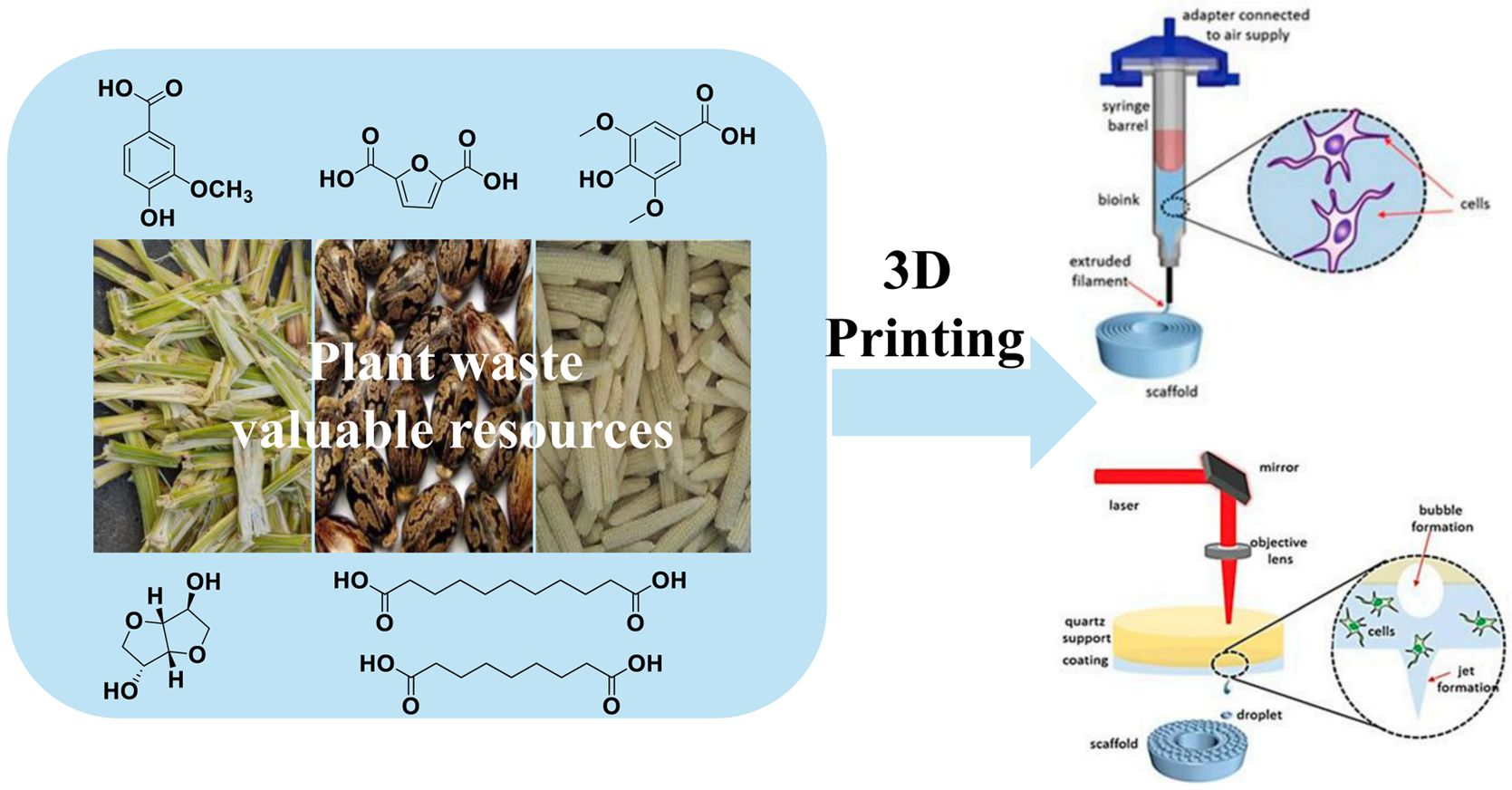
Beyond conventional graphic printing, bio-based polyesters support advanced additive manufacturing techniques, including 3D bioprinting, for next-generation packaging solutions.11,69 As illustrated in Figure 10, printing modalities such as inkjet, extrusion, and vat polymerization, commonly used in packaging, are adapted for depositing bio-inks containing bioactive compounds (antimicrobials, antioxidants) onto or within polyester-based substrates. This enables the development of active and intelligent packaging, where printed elements enhance food safety, extend shelf life, and support traceability.52,75 By integrating functional printing with bio-based polyesters, these technologies contribute to circular economy goals, reducing waste and enabling sustainable packaging solutions like compostable films and recyclable printing substrates.
3D-Printing. Bio-based polyesters, such as PLA and polycaprolactone (PCL), have shown significant promise in 3D-printing applications, particularly through melt-based Extrusion-based Hierarchical Deposition and Printing (EHDP). This technique enables the fabrication of intricate, customized structures for both biomedical and packaging applications.19,62 For instance, Liu’s group utilized EHDP to engineer PCL/gelatin (PCL/Gel) scaffolds for nerve repair, leveraging PCL’s flexibility to construct precise, complex conduits with tailored architecture,76 as shown in Figure 11. Similarly, Qin and Rafiqah’s group developed composite scaffolds from polyvinylpyrrolidone (PVP) and PCL using EHDP, demonstrating high-resolution printing for tissue engineering.28,77 These studies highlight EHDP’s versatility in producing scaffolds with controlled porosity and mechanical properties, advancing tissue regeneration applications. Beyond biomedical applications, EHDP’s precision and adaptability make it suitable for fabricating bio-based polyester structures for advanced packaging, such as customizable containers and protective films.10,34 The ability to tailor filament properties, such as flexibility and biodegradability, supports the development of sustainable 3D-printed packaging prototypes that align with circular economy principles. By integrating bio-based polyesters with EHDP, these advancements enable innovative applications in active and intelligent packaging, where printed structures can incorporate functional elements like antimicrobial coatings or sensors, enhancing food safety and shelf life.23,78 By integrating bio-based polyesters with EHDP, these advancements enable innovative applications in customizable, lightweight packaging prototypes that align with circular economy principles, supporting the development of sustainable packaging solutions.

|
Figure 10 Modalities for bioprinting technologies. (a) Extrusion-based bioprinting; (b) Scaffold-free bioprinting; (c) Inkjet bioprinting; (d) Laser-induced forward transfer bioprinting Reproduced with permission from Ref. 65, Aliotta, L. et al., Polymers, 2022, 14, 844. ©2022, MDPI. |

|
Figure 11 Architectures of multi-layered and composite scaffolds for tissue engineering: (a) A triple-layered PCL/Gel-based neural conduit (outer, middle, inner layers) fabricated via EHDP76 (b1-b2) PVP/PCL-based rings with an 800 μm radius, demonstrating high printing precision.66 (c1) Comparison of a rabbit tibia and a 3D-printed PCL replica; (c2) SEM image of the scaffold's surface; (c3) Assembly of the printed tibia section on electrospinning supports; (c4) SEM of electrospun PCL microfibers.79 (d) A PCL-based vascular scaffold; (d1) FDMprinted 3D patch and strands (6 mm scale); (d2) Microscopic image revealing the electrospun nanofiber matrix. Reproduced with permission from Refs. 66, 76, 79, 80, B.V. Tian, X. et al., J. Pain, 2021, 22, 180. ©2021, Elsevier. Liu, S. et al., Int. J. Biol. Macromol., 2021, 166, 1280. ©2021, Elsevier. B.V. Rosales-Ibáñez, R. et al., Polym. Bull., 2023, 80, 2533. ©2023, Springer Nature. Knospe, P. et al., J. Coat. Technol. Res., 2022, 19, 1799. ©2022, Springer Nature. |
The advancement of bio-based polyesters relies on leveraging lignocellulosic resources as renewable, cost-effective alternatives to fossil-based feedstocks. However, significant challenges hinder their widespread adoption. A key issue is balancing material performance with environmental benefits. Aliphatic polyesters offer biodegradability and biocompatibility but often lack the mechanical strength and thermal stability needed for broad applications.5,36 Incorporating lignin-derived aromatic monomers, such as 4-hydroxybenzoic acid, enhances the properties of aliphatic-aromatic copolyesters, but longer aliphatic spacers increase biodegradability at the expense of Tg, Tm, and thermal stability.37,81 Low crystallinity compared to conventional plastics like PET further limits performance, making it critical to optimize durability and degradability without compromising sustainability. Future research should focus on innovative design strategies to enhance performance, sustainability, and economic viability. Utilizing diverse biomass feedstocks and bio-based reactive diluents can support carbon-neutral production and circular economy models.67,70 Developing biodegradable polyesters from renewable raw materials, recycled plastics, or hybrid blends offers pathways to accelerate degradation in natural environments.18,82 Aliphatic-aromatic copolyesters, combining the thermal stability of aromatic units with the biodegradability of aliphatic chains, are promising for sustainable packaging. Novel biomass-derived monomers, such as 2,4-dihydroxyacetophenone, can expand structural diversity and functionality.63,83 Minimizing ecotoxicity is also essential to ensure safe environmental discharge.36,48 Additionally, additive manufacturing (3D printing) enables the production of lightweight, customizable packaging with minimal material waste, aligning with circular economy principles.10,11 These advancements position bio-based polyesters as promising sustainable alternatives for innovative packaging and printing applications, although further research is needed to address cost competitiveness, scalability, and standardization of degradation and recycling protocols.
Bio-based polyesters, derived from renewable monomer platforms such as carbohydrate-based diacids (FDCA, succinic acid), lignin-based aromatics, and plant-oil-derived polyols, have emerged as promising alternatives to petrochemical plastics by combining tunable thermal and mechanical properties, barrier performance, and, in many cases, biodegradability suitable for packaging and printing applications. Through careful control of aliphatic–aromatic balance, chain flexibility, and crystallinity via melt polycondensation, enzymatic routes, and ring-opening polymerization, these materials can be engineered to match or approach the performance of conventional polymers like PET, while partially or fully decoupling carbon feedstocks from fossil resources and enabling more sustainable end-of-life options such as industrial composting and chemical recycling. Quantitative comparisons indicate that partially bio-based polyesters such as PEF offer significantly improved gas barrier properties and higher Tg than PET, supporting high-barrier bottle and film applications, whereas thiophene-based aliphatic–aromatic copolyesters provide a broad window of stiffness, extensibility, and thermal resistance combined with enzyme-mediated degradability, which is attractive for compostable flexible packaging and printable substrates. Nonetheless, widespread adoption is constrained by challenges including the need to balance performance with rapid and predictable biodegradation across different environments, reduce production costs and process energy demand, ensure regulatory compliance and food-contact safety, and build circular infrastructure for collection, recycling, and composting tailored to these new materials. Future progress will depend on expanding the library of bio-based monomers, designing multi-functional composites and active/intelligent packaging systems, integrating additive manufacturing for customized low-waste formats, and conducting robust techno-economic and LCAs, so that renewable bio-based polyesters can transition from promising research targets to practical, scalable solutions that support carbon neutrality and circular economy goals in the packaging and printing sectors.
- 1. Wang, B.-X.; Cortes-Peña, Y.; Grady, B. P.; Huber, G. W.; Zavala, V. M. Techno-economic Analysis and Life Cycle Assessment of the Production of Biodegradable Polyaliphatic–polyaromatic Polyesters. ACS Sustain. Chem. Eng. 2024, 12, 9156-9167.
-

- 2. Chandra, R. Biodegradable Polymers. Prog. Polym. Sci. 1998, 23, 1273-1335.
-
- 3. Nath, D.; Misra, M.; Al-Daoud, F.; Mohanty, A. K. Studies on Poly(butylene succinate) and Poly(butylene succinate-co-adipate)-based Biodegradable Plastics for Sustainable Flexible Packaging and Agricultural Applications: A Comprehensive Review. RSC Sustainability 2025, 3, 1267-1302.
-
- 4. Loos, K.; Zhang, R.; Pereira, I.; Agostinho, B.; Hu, H.; Maniar, D.; Sbirrazzuoli, N.; Silvestre, A. J. D.; Guigo, N.; Sousa, A. F. A Perspective on Pef Synthesis, Properties, and End-life. Front. Chem. 2020, 8, 585.
-
- 5. Brodin, M.; Vallejos, M.; Opedal, M. T.; Area, M. C.; Chinga-Carrasco, G. Lignocellulosics as Sustainable Resources for Production of Bioplastics – A Review. J. Clean. Prod. 2017, 162, 646-664.
-
- 6. Rosenboom, J.-G.; Langer, R.; Traverso, G. Bioplastics for a Circular Economy. Nat. Rev. Mater. 2022, 7, 117-137.
-
- 7. Blanco-Cejas, J.; Martín, S.; Linares, M.; Iglesias, J.; Moreno, J. Life Cycle Assessment Applied to Bio-based Platform Molecules: Critical Review of Methodological Practices. J. Clean. Prod. 2023, 414, 137513.
-
- 8. Asgher, M.; Qamar, S. A.; Bilal, M.; Iqbal, H. M. N. Bio-based Active Food Packaging Materials: Sustainable Alternative to Conventional Petrochemical-based Packaging Materials. Food Res. Int. 2020, 137, 109625.
-
- 9. Donkor, L.; Kontoh, G.; Yaya, A.; Bediako, J.K.; Apalangya, V. Bio-based and Sustainable Food Packaging Systems: Relevance, Challenges, and Prospects. Appl. Food Res. 2023, 3, 100356.
-
- 10. Yang, E.; Miao, S.; Zhong, J.; Zhang, Z.; Mills, D. K.; Zhang, L.G. Bio-based Polymers for 3D Printing of Bioscaffolds. Polym. Reviews 2018, 58, 668-687.
-
- 11. Putri, K. N. A.; Intasanta, V.; Hoven, V. P. Current Significance and Future Perspective of 3D-printed Bio-based Polymers for Applications in Energy Conversion and Storage System. Heliyon 2024, 10, e25873.
-
- 12. Birkle, M.; Mehringer, H. S.; Nelson, T. F.; Mecking, S. Aliphatic Polyester Materials from Renewable 2,3-butanediol. ACS Sustain. Chem. Eng. 2024, 12, 4156-4163.
-
- 13. Lestido-Cardama, A.; Barbosa-Pereira, L.; Sendón, R.; Bustos, J.; Paseiro Losada, P.; Rodríguez Bernaldo de Quirós, A. Chemical Safety and Risk Assessment of Bio-based and/or Biodegradable Polymers for Food Contact: A Review. Food Res. Int. 2025, 202, 115737.
-
- 14. Thomsett, M. R.; Moore, J. C.; Buchard, A.; Stockman, R. A.; Howdle, S. M. New Renewably-sourced Polyesters From Limonene-derived Monomers. Green Chemistry 2019, 21, 149-156.
-
- 15. Takkellapati, S.; Li, T.; Gonzalez, M. A. An Overview of Biorefinery-derived Platform Chemicals from a Cellulose and Hemicellulose Biorefinery. Clean Technol. Environ. Policy 2018, 20, 1615-1630.
-
- 16. Fei, X.; Wang, J.; Zhang, X.; Jia, Z.; Jiang, Y.; Liu, X. Recent Progress on Bio-based Polyesters Derived from 2,5-furandicarbonxylic acid (FDCA). Polymers (Basel). 2022, 14, 625.
-
- 17. Xie, W.; Zhang, Y.; Zheng, H.; Lyu, P.; Ke, X.; Li, T.; Fang, H.; Sun, Y.; Dong, J.; Lin, L.; Wang, C.; Tang, X. Unlocking the Production of Biomass-derived Plastic Monomer 2,5-furandicarboxylic Acid At Industrial-level Concentration. ACS Catal. 2024, 14, 17510-17524.
-
- 18. Serra Sampaio, M.; Wojcieszak, R.; Itabaiana Junior, I. Synthesis of Bio‐based Polymers and Adjuvants Through Biomass Valorization: Challenges and Opportunities. ChemCatChem 2024, 16, e202301126.
-
- 19. Kainulainen, T. P.; Hukka, T. I.; Özeren, H. D.; Sirviö, J. A.; Hedenqvist, M. S.; Heiskanen, J. P. Utilizing Furfural-based Bifuran Diester as Monomer and Comonomer for High-performance Bioplastics: Properties of Poly(butylene furanoate), Poly(butylene bifuranoate), and Their Copolyesters. Biomacromolecules 2020, 21, 743-752.
-
- 20. Shaikh, S.; Yaqoob, M.; Aggarwal, P. An Overview of Biodegradable Packaging in Food Industry. Curr. Res. Food Sci. 2021, 4, 503-520.
-
- 21. Wu, J.; Eduard, P.; Thiyagarajan, S.; Jasinska-Walc, L.; Rozanski, A.; Guerra, C. F.; Noordover, B. A. J.; van Haveren, J.; van Es, D. S.; Koning, C. E. Semicrystalline Polyesters Based on a Novel Renewable Building Block. Macromolecules 2012, 45, 5069-5080.
-
- 22. Prateek, G.; Pooja, B.; Priyanka, D.; Harish, C. J.; Chauhan, P. K.; Mikhail, S. V.; Naveen, C. J.; Anna, K.; Adarchenko, I.; Vinod, K. Bio-based Food Packaging Materials: A Sustainable and Holistic Approach for Cleaner Environment - A Review. Macromol. Rapid Commun. 2016, 37, 643-649.
-
- 23. Zhang, H.; Jiang, M.; Wu, Y.; Li, L.; Wang, Z.; Wang, R.; Zhou, G. Development of High-molecular-weight Fully Renewable Biopolyesters Based on Oxabicyclic Diacid and 2,5-Furandicarboxylic Acid: Promising as Packaging and Medical Materials. ACS Sustain. Chem. Eng. 2021, 9, 6799-6809.
-
- 24. Rajendran, D. S.; Venkataraman, S.; Jha, S. K.; Chakrabarty, D.; Kumar, V. V. A Review on Bio-based Polymer Polylactic Acid Potential on Sustainable Food Packaging. Food Sci. Biotechnol. 2024, 33, 1759-1788.
-
- 25. Bokhari, S. M. Q.; Sevening, J. N.; Catchmark, J. M.; Chmely, S. C. Composition–property Engineering of Bio-derived UV-curable Acrylate Oligoester Resins for Tunable Mechanics in 3D Printing. RSC Appl. Polym. 2025, 3, 948-959.
-
- 26. Xu, H.; Cheng, Z.; Zhou, Z.; Djouonkep, L.D.W.; Gauthier, M. Biobased Polyesters Derived from 2-Methoxyhydroquinone: Impact of Cyclic and Alkyl Chain Segments on Their Thermomechanical Properties, Biodegradability, and Ecotoxicity. Chinese J. Polym. Sci. 2025, 43, 1320-1332.
-
- 27. Pospiech, D.; Korwitz, A.; Komber, H.; Jehnichen, D.; Häußler, L.; Scheibner, H.; Liebmann, M.; Jähnichen, K.; Voit, B. Biobased Aliphatic Polyesters with DOPO Substituents for Enhanced Flame Retardancy. Macromol. Chem. Phys. 2015, 216, 1447-1461.
-
- 28. Qin, P.; Wu, L.; Li, B.; Li, N.; Pan, X.; Dai, J. Superior gas barrier Properties of Biodegradable PBST vs. PBAT Copolyesters: A Comparative Study. Polymers (Basel). 2021, 13, 3449.
-
- 29. Barrett, D. G.; Luo, W.; Yousaf, M. N. Aliphatic Polyester Elastomers Derived From Erythritol and α,ω-diacids. Polym. Chem. 2010, 1, 296.
-
- 30. Yoshida, S.; Hiraga, K.; Takehana, T.; Taniguchi, I.; Yamaji, H.; Maeda, Y.; Toyohara, K.; Miyamoto, K.; Kimura, Y.; Oda, K. A Bacterium that Degrades and Assimilates Poly(ethylene terephthalate). Science. 2016, 351, 1196-1199.
-
- 31. Wei, R.; Oeser, T.; Schmidt, J.; Meier, R.; Barth, M.; Then, J.; Zimmermann, W. Engineered Bacterial Polyester Hydrolases Efficiently Degrade Polyethylene Terephthalate Due To Relieved Product Inhibition. Biotechnol. Bioeng. 2016, 113, 1658-1665.
-
- 32. Saxon, D. J.; Luke, A. M.; Sajjad, H.; Tolman, W. B.; Reineke, T. M. Next-generation Polymers: Isosorbide as a Renewable Alternative. Prog. Polym. Sci. 2020, 101, 101196.
-
- 33. Bautista, M.; Martínez de Ilarduya, A.; Alla, A.; Vives, M.; Morató, J.; Muñoz-Guerra, S. Cationic Poly(butylene succinate) Copolyesters. Eur. Polym. J. 2016, 75, 329-342.
-
- 34. Yang, W.; Ding, H.; Puglia, D.; Kenny, J.M.; Liu, T.; Guo, J.; Wang, Q.; Ou, R.; Xu, P.; Ma, P.; Lemstra, P. J. Bio‐renewable Polymers Based on Lignin‐derived Phenol Monomers: Synthesis, Applications, and Perspectives. SusMat 2022, 2, 535-568.
-
- 35. Li, S.; Xu, T.; Deng, M.; Jia, R.; Djouonkep, L.D.W. Structure–Property Relationships of Renewable Ternary Polyesters Derived from Vanillin-based Methyl Ester, Aliphatic Diacids, and Phenol Ether-based Diols. J. Polym. Environ. 2025, 33, 4147-4161.
-
- 36. Wang, Z.; Hu, J.; Wang, B.; Liu, Y.; Long, X. Synthesis and Characterization of Aromatic Copolyesters Derived from Bisphenol B and Phenol Red. J. Appl. Polym. Sci. 2023, 140, e54439.
-
- 37. Zhang, L.; Cheng, Z.; Wandji Djouonkep, L. D.; Gauthier, M. Synthesis and Characterization of Aliphatic-aromatic Copolyesters Based on Daidzein. Ind. Eng. Chem. Res. 2024, 63, 13445-13458.
-
- 38. Muringayil Joseph, T.; Azat, S.; Ahmadi, Z.; Moini Jazani, O.; Esmaeili, A.; Kianfar, E.; Haponiuk, J.; Thomas, S. Polyethylene Terephthalate (PET) Recycling: A Review. Case Studies in Chem. Environm. Eng. 2024, 9, 100673.
-
- 39. Hunsicker, D. M.; Dauphinais, B. C.; Mc Ilrath, S. P.; Robertson, N. J. Synthesis of High Molecular Weight Polyesters via in Vacuo Dehydrogenation Polymerization of Diols. Macromol. Rapid Commun. 2012, 33, 232-236.
-
- 40. Jiang, Y.; Woortman, A.; Van Ekenstein, G.; Loos, K. Enzyme-catalyzed Synthesis of Unsaturated Aliphatic Polyesters Based on Green Monomers from Renewable Resources. Biomolecules 2013, 3, 461-480.
-
- 41. Fujiki, S.; Amaike, K.; Yagi, A.; Itami, K. Synthesis, Properties, and Material Hybridization of Bare Aromatic Polymers Enabled by Dendrimer Support. Nat. Commun. 2022, 13, 5358.
-
- 42. Gao, Y.; Zhou, Y.; Huang, F.; Du, L. Preparation and Properties of Silicon-containing Arylacetylene Resin/benzoxazines Blends. High Perform. Polym. 2013, 25, 445-453.
-
- 43. Descamps, N.; Fernandez, F.; Heijboer, P.; Saint-Loup, R.; Jacquel, N. Isothermal Crystallization Kinetics of Poly(ethylene terephthalate) Copolymerized with Various Amounts of Isosorbide. Appl. Sci. 2020, 10, 1046.
-
- 44. Moreno, A.; Bensabeh, N.; Parve, J.; Ronda, J. C.; Cádiz, V.; Galià, M.; Vares, L.; Lligadas, G.; Percec, V. SET-LRP of Bio- and Petroleum-sourced Methacrylates in Aqueous Alcoholic Mixtures. Biomacromolecules 2019, 20, 1816-1827.
-
- 45. Djouonkep, L. D. W.; Tamo, C. T.; Simo, B. E.; Issah, N.; Tchouagtie, M. N.; Selabi, N. B. S.; Doench, I.; Kamdem Tamo, A.; Xie, B.; Osorio-Madrazo, A. Synthesis by Melt-polymerization of a Novel Series of Bio-based and Biodegradable Thiophene-containing Copolyesters with Promising Gas Barrier and High Thermomechanical Properties. Molecules 2023, 28, 1825.
-
- 46. Matos, M.; Sousa, A. F.; Fonseca, A. C.; Freire, C. S. R.; Coelho, J. F. J.; Silvestre, A. J. D. A New Generation of Furanic Copolyesters with Enhanced Degradability: Poly(ethylene 2,5‐furandicarboxylate)‐co ‐poly(lactic acid) Copolyesters. Macromol. Chem. Phys. 2014, 215, 2175-2184.
-
- 47. Park, H.; Goo, S.; Lee, S.; Kim, S. H. Thermal Decomposition Behavior of Carbon Nanotube Reinforced Thermotropic Liquid Crystalline Polymers. J. Appl. Polym. Sci. 2011, 122, 2060-2070.
-
- 48. Gigli, M.; Negroni, A.; Soccio, M.; Zanaroli, G.; Lotti, N.; Fava, F.; Munari, A. Influence of Chemical and Architectural Modifications on the Enzymatic Hydrolysis of Poly(butylene succinate). Green Chemistry 2012, 14, 2885.
-
- 49. Wang, P.; Huang, W.; Zhang, Y.; Lin, J.; Chen, P. An Evoluted Bio‐based 2,5‐furandicarboxylate Copolyester Fiber from Poly(ethylene terephthalate). Journal of Polymer Science 2020, 58, 320-329.
-
- 50. Yu, X.; Jia, J.; Xu, S.; Lao, K. U.; Sanford, M. J.; Ramakrishnan, R. K.; Nazarenko, S. I.; Hoye, T. R.; Coates, G. W.; DiStasio, R. A. Unraveling Substituent Effects on the Glass Transition Temperatures of Biorenewable Polyesters. Nat. Commun. 2018, 9, 2880.
-
- 51. Guidotti, G.; Soccio, M.; Lotti, N.; Gazzano, M.; Siracusa, V.; Munari, A. Poly(propylene 2,5-thiophenedicarboxylate) vs. Poly (propylene 2,5-furandicarboxylate): Two Examples of High Gas Barrier Bio-based Polyesters. Polymers (Basel). 2018, 10, 785.
-
- 52. Rothauer, D.; Mecking, S.; Nelson, T. F. Aliphatic–aromatic Copolyesters with Waste-sourceable Multiple Chain-length Building Blocks. ACS Sustain. Chem. Eng. 2025, 13, 3280-3288.
-
- 53. Tian, Y.; Hu, H.; Chen, C.; Li, F.; Bin Ying, W.; Zheng, L.; Wang, J.; Zhang, R.; Zhu, J. Enhanced Seawater Degradation Through Copolymerization with Diglycolic Acid: Synthesis, Microstructure, Degradation Mechanism and Modification for Antibacterial Packaging. Chem. Eng. J. 2022, 447, 137535.
-
- 54. Tian, S.; Shi, K.; Xu, J.; Guo, B. Synthesis and Structure–property Relationships of Novel High Molecular Weight Fully Biobased 2,5-thiophenedicarboxylic Acid-based Polyesters. Biomacromolecules 2023, 24, 2998-3008.
-
- 55. Djouonkep, L. D. W; Cheng, Z.; Siegu, W. M. K.; Jing, X.; Chen, J.; Adom, E. K.; Muaz, A.; Gauthier, M. High Performance Sulfur-containing Copolyesters from Bio-sourced Aromatic Monomers. Express Polym. Lett. 2022, 16, 102-114.
-
- 56. Djouonkep, L. D. W.; Tamo, A. K.; Doench, I.; Selabi, N. B. S.; Ilunga, E. M.; Lenwoue, A. R. K.; Gauthier, M.; Cheng, Z.; Osorio-Madrazo, A. Synthesis of High Performance Thiophene–aromatic Polyesters from Bio-sourced Organic Acids and Polysaccharide-derived Diol: Characterization and Degradability Studies. Molecules 2022, 27, 325.
-
- 57. Wang, Q.; Li, J.; Wang, J.; Hu, H.; Dong, Y.; O’Young, D. L.; Hu, D.; Zhang, X.; Wei, D.-Q.; Zhu, J. Biobased Biodegradable Copolyesters from 2,5-thiophenedicarboxylic Acid: Effect of Aliphatic Diols on Barrier Properties and Degradation. Biomacromolecules 2023, 24, 5884-5897.
-
- 58. Wang, J.-G.; Zhang, X.-Q.; Shen, A.; Zhu, J.; Song, P.-A.; Wang, H.; Liu, X.-Q. Synthesis and Properties Investigation of Thiophene-aromatic Polyesters: Potential Alternatives for the 2,5-furandicarboxylic Acid-based Ones. Chinese J. Polym. Sci. 2020, 38, 1082-1091.
-
- 59. Bouyahya, C.; Patrício, R.; Paço, A.; Lima, M. S.; Fonseca, A. C.; Rocha-Santos, T.; Majdoub, M.; Silvestre, A. J. D.; Sousa, A. F. Isosorbide and 2,5-furandicarboxylic Acid Based (co)polyesters: Synthesis, Characterization, and Environmental Degradation. Polymers 2022, 14, 3868.
-
- 60. Kanasty, R. L.; Vegas, A. J.; Ceo, L. M.; Maier, M.; Charisse, K.; Nair, J. K.; Langer, R.; Anderson, D. G. Sequence‐defined Oligomers from Hydroxyproline Building Blocks for Parallel Synthesis Applications. Angew. Chem. Int. Ed. 2016, 55, 9529-9533.
-
- 61. Bianchi, E.; Soccio, M.; Siracusa, V.; Gazzano, M.; Thiyagarajan, S.; Lotti, N. Poly(butylene 2,4-furanoate), An Added Member to the Class of Smart Furan-based Polyesters for Sustainable Packaging: Structural Isomerism as a Key to Tune the Final Properties. ACS Sustain. Chem. Eng. 2021, 9, 11937-11949.
-
- 62. Kamdem Tamo, A.; Doench, I.; Morales Helguera, A.; Hoenders, D.; Walther, A.; Madrazo, A. O. Biodegradation of Crystalline Cellulose Nanofibers by Means of Enzyme Immobilized-alginate Beads and Microparticles. Polymers 2020, 12, 1522.
-
- 63. Papageorgiou, D. G.; Guigo, N.; Tsanaktsis, V.; Exarhopoulos, S.; Bikiaris, D. N.; Sbirrazzuoli, N.; Papageorgiou, G. Z. Fast Crystallization and Melting Behavior of a Long-spaced Aliphatic Furandicarboxylate Biobased Polyester, Poly(dodecylene 2,5-furanoate). Ind. Eng. Chem. Res. 2016, 55, 5315-5326.
-
- 64. Demirel, B.; İnaner, N. B.; Gezer, D. U.; Daver, F.; Yaras, A.; Akkurt, F. Chemical, Thermal, and Mechanical Properties and Ultraviolet Transmittance of Novel Nano‐hydroxyapatite/polyethylene Terephthalate Milk Bottles. Polym. Eng. Sci. 2021, 61, 2043-2054.
-
- 65. Aliotta, L.; Seggiani, M.; Lazzeri, A.; Gigante, V.; Cinelli, P. A Brief Review of Poly(butylene succinate) (PBS) and Its Main Copolymers: Synthesis, Blends, Composites, Biodegradability, and Applications. Polymers 2022, 14, 844.
-
- 66. Tian, X.; Zhu, H.; Du, S.; Zhang, X.-Q.; Lin, F.; Ji, F.; Tsou, Y.-H.; Li, Z.; Feng, Y.; Ticehurst, K.; Hannaford, S.; Xu, X.; Tao, Y.-X. Injectable PLGA-coated Ropivacaine Produces a Long-lasting Analgesic Effect on Incisional Pain and Neuropathic Pain. J. Pain 2021, 22, 180-195.
-
- 67. Nukala, S. G.; Kong, I.; Patel, V. I.; Kakarla, A. B.; Kong, W.; Buddrick, O. Development of Biodegradable Composites Using Polycaprolactone and Bamboo Powder Polymers 2022, 14, 4169.
-
- 68. Kunduru, K. R.; Hogerat, R.; Ghosal, K.; Shaheen-Mualim, M.; Farah, S. Renewable Polyol-based Biodegradable Polyesters as Greener Plastics for Industrial Applications. Chem. Eng. J. 2023, 459, 141211.
-
- 69. Atarés, L.; Chiralt, A.; González-Martínez, C.; Vargas, M. Production of Polyhydroxyalkanoates for Biodegradable Food Packaging Applications Using Haloferax Mediterranei and Agrifood Wastes. Foods 2024, 13, 950.
-
- 70. Guo, Z.; Zhang, H.; Chen, H.; Zhang, M.; Tang, X.; Wang, M.; Ma, D. Hydrogenating Polyethylene Terephthalate Into Degradable Polyesters. Ang. Chem. Int. Ed. 2025, 64, e202418157.
-
- 71. Wang, G.; Yang, G.; Jiang, M.; Wang, R.; Liang, Y.; Zhou, G. Poly(propylene naphthalate-co-propylene 2,5-thiophenedicarboxylate)s Derived from Bio-based 2,5-thiophenedicarboxylic Acid (TDCA): Synthesis and Properties. Polym. Test. 2021, 93, 106955.
-
- 72. Steinmann, W.; Walter, S.; Beckers, M.; Seide, G.; Gries, T. Thermal Analysis of Phase Transitions and Crystallization in Polymeric Fibers. In Applications of Calorimetry in a Wide Context - Differential Scanning Calorimetry, Isothermal Titration Calorimetry and Microcalorimetry; Elkordy, A.A., Ed.; InTech: Rijeka, 2013.
-
- 73. Siegu, W. M. K.; Djouonkep, L. D. W.; Selabi, N. B. S.; Bonku, E. M.; Cheng, Z.; Gauthier, M. Synergistic Effect and Structure–property of Bio-based 1,6-hexanediol on Thermal, Mechanical and Degradation Properties of Biopolymers. J. Polym. Environ. 2023, 31, 1144-1159.
-
- 74. Shin, S. M.; Kim, S. H.; Song, J. K. Thermal Decomposition Behavior and Durability Evaluation of Thermotropic Liquid Crystalline Polymers. Macromol. Res. 2009, 17, 149-155.
-
- 75. Gopal, L.; Sudarshan, T. Surface Modification of Polyester. Surface Engineering 2025, 41, 143-148.
-
- 76. Liu, S.; Sun, L.; Zhang, H.; Hu, Q.; Wang, Y.; Ramalingam, M. High-resolution Combinatorial 3D Printing of Gelatin-based Biomimetic Triple-layered Conduits for Nerve Tissue Engineering. Int. J. Biol. Macromol. 2021, 166, 1280-1291.
-
- 77. Rafiqah, S. A.; Khalina, A.; Harmaen, A. S.; Tawakkal, I. A.; Zaman, K.; Asim, M.; Nurrazi, M. N.; Lee, C. H. A Review on Properties and Application of Bio-based Poly(butylene succinate). Polymers 2021, 13, 1436.
-
- 78. Yi, H.-G.; Kim, H.; Kwon, J.; Choi, Y.-J.; Jang, J.; Cho, D.-W. Application of 3D Bioprinting in the Prevention and the Therapy for Human Diseases. Signal Transduct. Target. Ther. 2021, 6, 177.
-
- 79. Rosales-Ibáñez, R.; Viera-Ruiz, A. E.; Cauich-Rodríguez, J. V.; Carrillo-Escalante, H. J.; González-González, A.; Rodríguez-Martínez, J. J.; Hernández-Sánchez, F. Electrospun/3D-printed PCL Bioactive Scaffold for Bone Regeneration. Polym. Bull. 2023, 80, 2533-2552.
-
- 80. Knospe, P.; Seithümmer, J.; Reichmann, R.; Gutmann, J. S.; Hoffmann-Jacobsen, K.; Dornbusch, M. Impact of Enzymatically Synthesized Aliphatic–aromatic Polyesters with Increased Hydroxyl Group Content on Coating Properties. J. Coat. Technol. Res. 2022, 19, 1799-1808.
-
- 81. Upton, B. M.; Kasko, A. M. Strategies for the Conversion of Lignin to High-value Polymeric Materials: Review and Perspective. Chem. Rev. 2016, 116, 2275-2306.
-
- 82. Paek, K. H.; Im, S. G. Biodegradable Aromatic–aliphatic Copolyesters Derived from Bis(2-hydroxyethyl) Terephthalate for Sustainable Flexible Packaging Applications. ACS Appl. Polym. Mater. 2022, 4, 5298-5307.
-
- 83. Stanley, J.; Terzopoulou, Z.; Klonos, P. A.; Zamboulis, A.; Xanthopoulou, E.; Koltsakidis, S.; Tzetzis, D.; Zemljič, L. F.; Lambropoulou, D. A.; Kyritsis, A.; Papageorgiou, G. Z.; Bikiaris, D. N. Effect of Monomer Type on the Synthesis and Properties of Poly(ethylene furanoate). Polymers 2023, 15, 2707.
-

- Polymer(Korea) 폴리머
- Frequency : Bimonthly(odd)
ISSN 2234-8077(Online)
Abbr. Polym. Korea - 2025 Impact Factor : 1.0
- Indexed in SCIE
 This Article
-
2026; 50(3): 383-401
Published online May 25, 2026
- 10.7317/pk.2026.50.3.383
- Received on Feb 2, 2026
- Revised on Feb 24, 2026
- Accepted on Mar 6, 2026
Services
- Full Text PDF
- Abstract
- ToC
- Acknowledgements
- Conflict of Interest
Introduction
Biobased Monomer Platforms
Structural Design and Synthesis
Structure-Property Relationships
Packaging and Printing Applications
Challenges and Future Prospects
Conclusions
- References
Shared
Correspondence to
- Lijuan He*, Wandji Djouonkep**
-
*School of Intelligent Manufacturing, Wuhan Railway Vocational College of Technology, Wuhan 430205, China
**Institute of Fine Organic Chemicals & Organic Materials, School of Chemistry and Chemical Engineering, Wuhan University of Science and Technology, Wuhan 430081, China - E-mail: hljkk251314@163.com, dasilvawdl@outlook.com
- ORCID:
0009-0004-1043-2680, 0000-0002-8190-5391
 Copyright(c) The Polymer Society of Korea. All right reserved.
Hyecheon Building(Room 601), #354, Gangnam-Daero, Gangnam-Gu, Seoul 06242, Korea
TEL : 82-2-568-3860, 561-5203, 569-3860 FAX : 82-2553-6938 E-mail: polymer@polymer.or.kr