








- Rheological and Textural Properties of Hydrogel Formulations Containing Nanostructured Lipid Carriers (NLCs) with Different Types of Polymeric Thickeners
Ju-Yeong Shin and Byung Suk Jin†

Division of Chemistry and Cosmetics, Dongduk Women’s University, Seoul 02748, Korea
- 고분자 점증제 종류에 따른 나노구조 지질담체(NLC) 함유 하이드로젤 제형의 유변학적 및 텍스처 특성
신주영 · 진병석†
동덕여자대학교 화학·화장품학부
Reproduction, stored in a retrieval system, or transmitted in any form of any part of this publication is permitted only by written permission from the Polymer Society of Korea.
Tocopherol-loaded nanostructured lipid carriers (NLCs) were incorporated into hydrogels formulated with various polymeric thickeners. The stability, rheological properties, and texture of the hydrogel formulations were compared according to the type of polymeric thickener, and the effects of interactions between polymers and NLCs on the final hydrogel properties were investigated. The Herschel–Bulkley model was applied to the shear rate–shear stress curves of the hydrogel formulations to calculate rheological parameters such as the shear-thinning index and yield stress. In formulations based on alkyl acrylate crosspolymers, nonpolar van der Waals interactions between the alkyl chains of the polymer and the fatty acid chains of the phospholipids constituting the NLC strengthened the network structure, leading to increased viscosity and hardness of the formulations. In contrast, the cationic polymer chitosan induced aggregation and complex formation through electrostatic interactions with the anionic surfactants contained in the NLCs, resulting in decreased formulation stability.
토코페롤이 포집된 나노구조 지질담체(NLC)를 다양한 고분자 증점제를 사용한 하이드로젤 제형에 적용하였다. 고분자 증점제의 종류에 따른 하이드로젤 제형의 안정성, 레올로지 특성 및 텍스처를 비교하였으며, 고분자와 NLC 간의 상호작용이 최종 하이드로젤 특성에 미치는 영향을 분석하였다. 전단 속도-전단 응력 곡선에는 Herschel-Bulkley 모델을 적용하여 전단박화 지수 및 항복응력과 같은 레올로지 파라미터를 도출하였다. 알킬 아크릴레이트 크로스폴리머 기반 제형에서는 고분자의 알킬 사슬과 NLC를 구성하는 인지질의 지방산 사슬 간 비극성 반데르발스 상호작용에 의해 네트워크 구조가 강화되었으며, 이에 따라 점도와 경도가 증가하였다. 반면, 양이온성 고분자인 키토산의 경우 NLC 내 음이온성 계면활성제와의 정전기적 상호작용을 통해 응집 및 복합체 형성을 유도하여 제형의 안정성을 저하시켰다.
The viscosity increase observed upon adding nanostructured lipid carrier (NLC) dispersion to the crosspolymer thickener solution is due to nonpolar van der Waals interactions between crosspolymer alkyl chains (C10–30) and NLC particles, reinforcing the polymer network.
Keywords: nanostructured lipid carriers, hydrogel, polymeric thickener, rheological characteristics, texture.
The authors declare that there is no conflict of interest.
Solid lipid nanoparticles (SLNs) have attracted considerable attention in the pharmaceutical and cosmetic industries as delivery carriers for active ingredients due to their advantages, such as biocompatibility, controlled drug release, and enhanced skin penetration. However, their practical application has been limited by several drawbacks, including low drug-loading capacity within the lipid matrix, leakage of active compounds during storage, and instability arising from lipid crystallization.1-3 To overcome these limitations, nanostructured lipid carriers (NLCs) were developed. NLCs are characterized by an imperfect crystalline structure formed by mixing solid and liquid lipids (oils), which creates structural imperfections in the lipid matrix and increases the available space for encapsulating active ingredients.
Consequently, NLCs offer improved drug solubility and encapsulation efficiency while minimizing drug leakage during storage.4-7 In addition, NLCs exhibit superior chemical stability against heat and light, preventing oxidation and degradation.8 By adjusting the ratio of solid to liquid lipids, the release rate of active compounds can be finely controlled, allowing sustained delivery and longterm stability of their efficacy.9-11 Recent studies have also reported that NLCs can enhance the efficacy of UV filters,12,13 and further advances in surface modification and multifunctional design have expanded their potential applications as targeted or stimuli-responsive delivery systems.14-16 In our previous study, we focused on the self-assembled co-structures formed through the mutual interactions between ceramides and phospholipids. Based on this finding, we developed NLCs containing a high content of ceramide and optimized their composition.17 Tocopherol was encapsulated as a model active ingredient, and its stabilization effect against oxidative degradation
within the NLC matrix was confirmed. Considering the comprehensive advantages of NLCs, they are regarded as a promising nanocarrier platform for next-generation pharmaceutical and cosmetic formulations. Nevertheless, studies applying NLCs to practical formulation systems remain limited. Therefore, in this study, tocopherol-loaded NLCs were incorporated into hydrogel formulations using various polymeric thickeners to investigate the interactions between NLC droplets and polymeric thickener and their influence on the final formulation properties. Furthermore, the stability, rheological properties, and texture of the hydrogel formulations made with each type of polymeric thickener were comparatively analyzed.
Materials. The phospholipid used in this study was Emulmetik 950 (Lucas Meyer, France), which contains more than 95% phosphatidylcholine and is fully hydrogenated to eliminate unsaturated components; for convenience, it is referred to as HPC throughout this paper. The ceramide (CER) used was DS-Ceramide Y30 (Solus Advanced Materials, Korea). Sodium deoxycholate (SDOC) was obtained from Sigma-Aldrich (USA). The liquid oil component was cetyl ethylhexanoate (CEH) supplied by Osung Chemical (Korea), while polysorbate 80 (TW80), used as the surfactant, was purchased from ICI (UK). The preservative Microsafe HBO was purchased from Choice & Teck (Korea), DL-α-tocopherol from DSM (Netherlands), and ethanol (99.5% purity) from Daejung Chemical (Korea).
For the preparation of NLC-based hydrogel formulations, five different polymers were employed as gelling agents : carbomer (Carbopol 940, Lubrizol, USA), acrylates/C10-30 alkyl acrylate crosspolymer (Pemulen TR-1, Lubrizol, USA; hereafter referred to as crosspolymer), hydroxyethyl cellulose (Natrosol 250HHR, Ashland, USA; referred to as Hycell), guar gum (Shree Vijaylaxmi, India), and chitosan (Chibio Biotech, China). In addition to the polymers, the final formulations contained humectants such as glycerin (Palm-Oleo, Malaysia) and 1,3-butylene glycol (Daicel, Japan), as well as skin-conditioning ingredients niacinamide (DSM-Firmenich, Switzerland) and allantoin (Merck, Germany).
Potassium hydroxide (KOH) (Daejung Chemical, Korea) was used as an alkalizing agent.
Preparation. NLCs were prepared according to the method previously reported by our research group.17 The composition and weight ratio of the NLC components were as follows : 2.5 g of CEH and 2.5 g of ethanol (total 5 g), 2 g of CER, 4 g of HPC, 2 g of TW 80, 0.25 g of SDOC, 1 g of HBO, and 0.25 g of tocopherol. The remaining amount was adjusted with distilled water to obtain a total of 100 g of NLC dispersion.
The NLC-containing hydrogel formulations (shown in Table 1) were prepared as follows. First, thickener solutions were prepared for each type of polymer. The synthetic polymers, carbomer and crosspolymer, were dissolved in water at a concentration of 1%. In contrast, the natural polymers such as hycell, guar gum, and chitosan, exhibited insufficient viscosity for cosmetic formulation applications, and therefore, their concentration was adjusted to 2%.
Since both synthetic polymers belong to the acrylic acid series, 0.5% KOH was added to enhance the thickening efficiency. Subsequently, humectants, skin-conditioning agents, and preservative were added to the thickening solution, followed by the addition of the NLC dispersion. The mixtures were stirred with an Azi-mixer (T.K. PRIMIX Co.) for approximately 3 minutes and then hand-mixed to complete the formulation. For convenience, the polymeric thickener solution, the mixture of humectants and functional ingredients, and the tocopherol-loaded NLC dispersion were designated as the P phase, H phase, and N phase, respectively. The mixing ratio (by weight) of P phase : H phase : N phase was fixed at 40 : 10 : 50.
Characterization. The stability of the NLC dispersion and the final hydrogel formulations was evaluated using a turbiscan AGS (Microtrac). Each sample was placed in a glass cell and mounted on the turbiscan, and near-infrared light (880 nm) was irradiated at room temperature every 4 h for 3 days to monitor changes in the backscattered (BS) light intensity. The rheological flow properties of the formulations were analyzed using a Brookfield RSX Cone Plate rheometer by
measuring changes in viscosity and shear stress while varying the shear rate at room temperature. The viscoelastic properties were examined using a rotational rheometer (ARES-G2, TA Instruments) equipped with a 25 mm plate, under frequency sweep conditions ranging from 0.1 to 1000 Hz at room temperature.
The texture properties of the formulations were evaluated using a texture analyzer (CT3 model, Brookfield) through texture profile analysis (TPA). The probe used for measurementwas TA10 (cylinder type, 12.7 mm diameter, 35 mm length). Measurements began under a trigger force of 1 g, with the probe moving downward and upward twice at a speed of 1.0 mm/s and a penetration distance of 15.0 mm. For each formulation, at least three samples were tested, and the average values of the measured data were calculated.
|
Table 1 Formulations of NLC-containing Hydrogels Prepared with Different Polymers (w/w%) |

*P-CA and P-CR include 0.5% KOH |
Figure 1 shows the appearance of NLC-containing hydrogel formulations prepared with different polymeric thickeners. The CA and CR formulations exhibited creamlike, opaque white gels, whereas the HY and GG formulations displayed slightly bluish, translucent gels with viscous and flowable characteristics. The CT formulation containing the cationic polymer chitosan showed slight phase separation immediately after mixing, resulting in a non-homogeneous appearance and decreased stability. This instability is attributed to electrostatic interactions between the anionic surfactant SDOC (a component of the NLC) and the cationic polymer, which promote aggregation and complex formation.18,19
After preparing the NLC-containing hydrogel formulations, their stability was evaluated using a Turbiscan. Figure 2 presents the backscattering (BS) profiles over three days for the NLC dispersion (a), the CA formulation (b), and the GG formulation (c). The x-axis in Figure 2 represents the height within the sample cell, with increasing x-values corresponding to the upper region of the cell. For the NLC dispersion, the BS signal gradually changed with time, indicating sedimentation due to droplet aggregation initiated in the upper layer. In contrast, both hydrogel formulations (CA and GG) maintained nearly constant BS values throughout the sample height over three days, confirming their relative stability.
The difference in backscattering (BS) intensity between the CA and GG formulations can be attributed to differences in their light scattering behavior, which are closely related to their internal microstructures. The CA formulation was prepared by dispersing NLCs in a carbomer-thickened system, whereas the GG formulation consists of NLCs dispersed in a guar gum-thickened system. Carbomer forms a more highly crosslinked three-dimensional network, resulting in a non-flowing gel structure, while guar gum forms a comparatively weaker and more flowable network. Due to its stronger network structure, carbomer more effectively immobilizes and traps NLC particles within the gel matrix.
This results in a higher degree of microstructural heterogeneity in the CA formulation, which in turn enhances light scattering. In contrast, the GG formulation, with its weaker network and greater mobility of dispersed particles, exhibits relatively lower heterogeneity and reduced light scattering.
Therefore, the higher BS intensity and more opaque appearance of the CA formulation originate from its stronger network structure and the resulting increase in microstructural heterogeneity.
To investigate the polymer-dependent differences in hydrogel appearance, the refractive indices of the polymeric thickener solution (P phase) and the corresponding hydrogel formulations were measured. As shown in Table 2, all P phases exhibited refractive indices between
1.334 and 1.335, similar to that of pure water (1.333), indicating negligible differences among the polymer solutions. By contrast, the NLC dispersion (N phase) and the humectant/additive mixture (H phase) showed refractive indices of 1.350 and 1.364, respectively. The final hydrogel formulations prepared by mixing these 3 phases all exhibited the same refractive index (1.358), regardless of the thickener used. Thus, the differences in hydrogel appearance are more likely due to polymer-dependent dispersion states of NLC droplets rather than differences in refractive index.
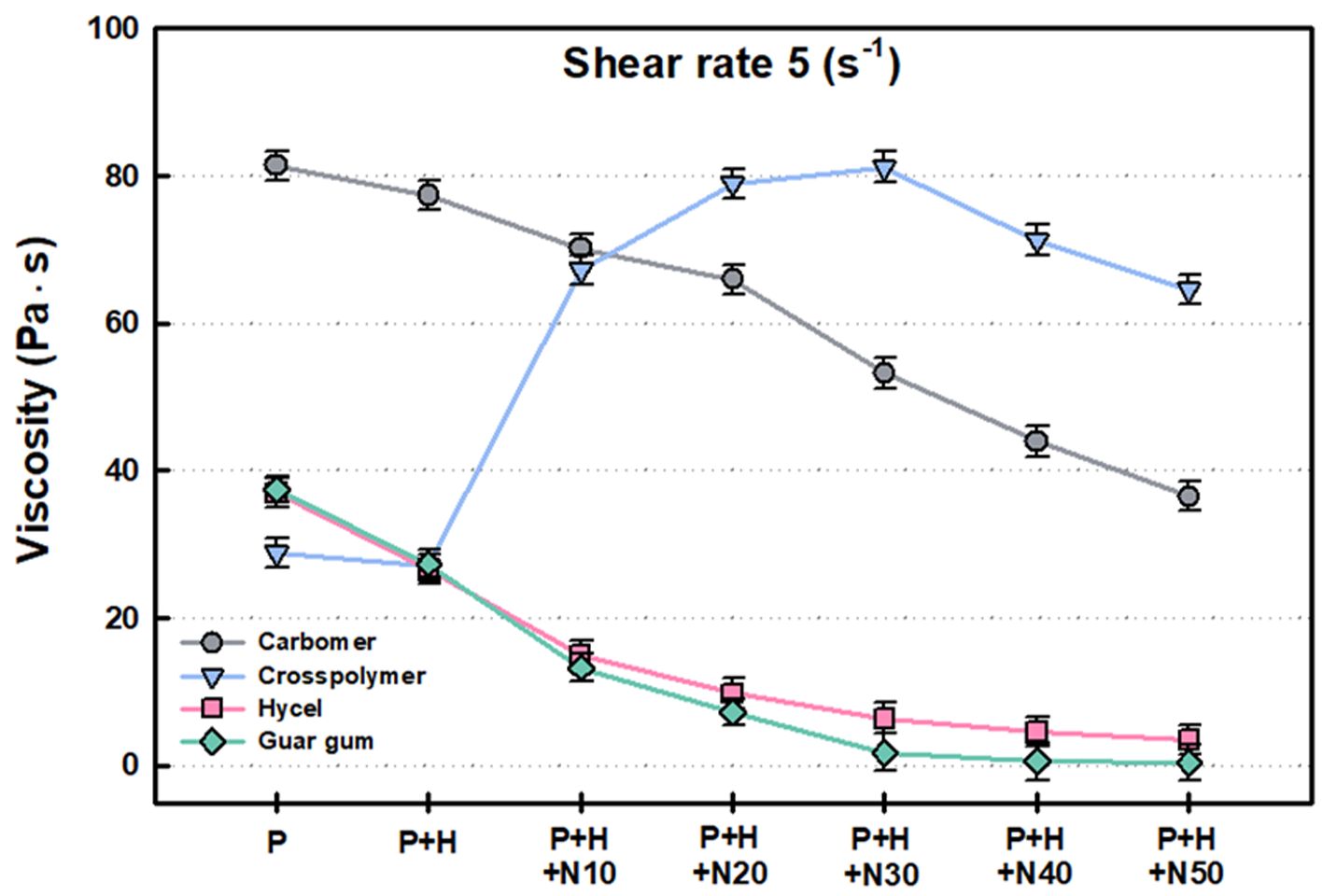
Figure 3 presents the viscosities of the neat polymeric thickener solution (P phase), the P+H phase (P phase mixed with H phase), and the mixture obtained by stepwise addition of NLC dispersion (N phase) at 10% increments to the P+H phase. Among the P phases, the carbomer solution exhibited the highest viscosity, while the crosspolymer solution showed the lowest. Generally, addition of the H and N phases diluted the polymer solutions, resulting in an overall decrease in viscosity. However, in the case of the crosspolymer solution, a distinct increase in viscosity was observed upon addition of the N phase. To elucidate this phenomenon, each NLC component (HPC, CER, SDOC, and CEH) was individually added at 1 wt% to the crosspolymer solution. As shown in Figure 4, only HPC produced a pronounced viscosity increase. This behavior is attributed to nonpolar van der Waals interactions between the hydrophobic alkyl chains (C10–30) of the crosspolymer and the fatty acid chains of HPC, allowing NLC droplets to act as physical crosslinking sites and thereby reinforcing the polymer network.20-22
Figure 5 compares the viscoelastic properties and complex viscosities of the carbomer thickener solution (P-CA) and its hydrogel (CA), as well as those of the crosspolymer thickener solution (P-CR) and its corresponding hydrogel (CR). For the (a) P-CA and (b) CA samples, the CA hydrogel exhibited slightly lower storage modulus (G′) and higher loss modulus (G″) than the P-CA solution. This indicates that the hydrogel exhibits greater viscous dissipation and enhanced fluidity compared to the carbomer thickener solution. Such behavior can be attributed to the incorporation of liquid components such as the NLC dispersion and humectants, which partially disrupt the polymer network and increase chain mobility.
In the case of (c) P-CR and (d) CR samples, a distinctly different behavior was observed. The P- CR solution exhibited lower G′, G″, and complex viscosity (η*) than the carbomer solution. However, upon addition of humectants and the NLC dispersion in the CR hydrogel, all three parameters increased markedly compared to the P-CR solution. Notably, the pronounced rise in G′ suggests that, in addition to the inherent chemical crosslinking within the crosspolymer chains, secondary physical interactions were formed between the crosspolymer and NLC components, leading to the reinforcement of the elastic network structure. This enhancement in storage modulus is considered to directly contribute to the increased viscosity of the hydrogel.
Figure 6 shows the changes in viscosity of hydrogel formulations containing different types of
polymers as a function of shear rate. Among all formulations, the CR hydrogel exhibited the highest viscosity, while the GG hydrogel showed the lowest across the entire shear rate range. All hydrogels demonstrated typical shear-thinning behavior characteristic of non-Newtonian fluids, in which viscosity decreases with increasing shear rate. This phenomenon is attributed to the partial breakdown and rearrangement of the internal network structure under shear stress, leading to reduced flow resistance.
The CA and CR hydrogels prepared with synthetic polymers exhibited more pronounced shearthinning behavior compared to the HY and GG hydrogels based on natural polymers. This is likely due to the stronger network structures of synthetic polymers, which possess a greater degree of chemical crosslinking and chain entanglement. Hydrogels showing a marked shear-thinning behavior have the advantage of maintaining high viscosity and thus enhanced stability during storage, while exhibiting reduced viscosity during application, resulting in improved spreadability.
Figure 7 illustrates the variation in shear stress as a function of shear rate for the hydrogel formulations. The CA and CR hydrogels exhibited substantially higher shear stress values than the HY and GG hydrogels, particularly with sharp increase at low shear rate. In contrast, the HY and GG hydrogels displayed a gradual increase in shear stress across the entire shear-rate range. All samples in Figure 7 exhibited clear yield stresses and nonlinear shear stress-shear rate curves. Accordingly, the Herschel- Bulkley model equation shown below was applied to the curves, and the derived rheological parameters were summarized in Table 3.

τ: shear stress, du/dy: shear rate, τ0: yield stress, K: consistency coefficient, n: shear thinning index All hydrogels exhibited R2 values above 0.99, indicating excellent conformity to the model. The CA and CR hydrogels based on synthetic polymers exhibited significantly higher yield stress (τ0) and consistency coefficient (K) than the HY and GG hydrogels based on natural polymers. These results reflect stronger and more resistant network structures of the synthetic polymer. The shear- thinning index (n) is an exponent that characterizes the flow behavior of a fluid, where n = 1 corresponds to a Newtonian fluid and n < 1 indicates a non-Newtonian fluid with stronger shear-thinning behavior. The n value was lowest for the CR hydrogel, which had the highest viscosity, and highest for the GG hydrogel, consistent with their viscosity profiles.
Figure 8 presents the texture properties of each hydrogel formulation obtained from the TPA analysis. The CR hydrogel, which exhibited the strongest network structure, showed the highest hardness and adhesiveness, followed by the CA hydrogel. These results confirm the structural robustness of synthetic polymer–based hydrogels. In contrast, the HY and GG hydrogels showed low hardness (< 200 Pa) and low adhesiveness (< 1 mJ). These low textural attributes suggest that these hydrogels may be suitable for ampoule-type products that require high fluidity.
Creaminess was markedly higher in the synthetic polymer–based hydrogels (CA and CR) than natural polymer–based hydrogels (HY and GG), with the CA hydrogel exhibiting superior creaminess relative to CR. This can be attributed to greater chain entanglement in carbomer relative to crosspolymer. Cohesiveness, defined as the ability of a sample to recover its original form after deformation, was slightly higher in the HY and GG hydrogels than in the synthetic polymer–based hydrogels, suggesting that they may provide a more stable, uniform spreading sensation during application.
Overall, these results demonstrate that the texture properties of hydrogels are strongly influenced by the type of the polymer used, emphasizing the importance of selecting appropriate polymers according to the intended final application.

|
Figure 1 Comparison of the appearance of NLC-containing hydrogels according to polymer type. |

|
Figure 2 Turbiscan backscattering profiles of (a) NLC solution; (b) CA hydrogel; (c) GG hydrogel. |

|
Figure 3 Change in viscosity with the progressive addition of H phase and N phase to the polymer thickening solution. |

|
Figure 4 Viscosity changes when each of NLC constituents was added into the crosspolymer thickener solution (P-CR). |

|
Figure 5 Frequency-dependent viscoelastic behaviors of polymeric thickener solutions and NLC-containing hydrogel formulations prepared with carbomer and crosspolymer. |

|
Figure 6 Shear rate–dependent viscosity changes of NLC-containing hydrogel formulations with different polymers. |

|
Figure 7 Shear stress–shear rate curves for NLC-containing hydrogel formulations with different polymers. |

|
Figure 8 Texture comparison of NLC-containing hydrogel formulations with different polymers: (a) hardness; (b) adhesiveness; (c) creaminess; (d) cohesiveness. |
|
Table 2 Refractive Index Values of N, H, and P Phases and Hydrogel Formulation |

Water: 1.333 |
|
Table 3 Determination of Herschel-Bulkley Parameters in NLC-containing Hydrogels Prepared with Different Polymers |

Upon incorporating various polymeric thickener solutions into the tocopherol-loaded NLC dispersion to prepare hydrogel formulations, distinct differences in appearance were observed depending on the polymer type. Formulations produced with synthetic polymers such as carbomer and crosspolymer exhibited an opaque, white, cream-like appearance with minimal fluidity. In contrast, formulations prepared with natural polymers such as hycell and guar gum appeared slightly bluish, translucent, and more flowable. The viscosity of the crosspolymer-based hydrogel formulation was higher than that of the neat polymeric thickener solution, which can be attributed to nonpolar van der Waals interactions between the polymer and the NLC particles. When the Herschel–Bulkley model was applied to the shear rate–shear stress curves of the hydrogels, the synthetic polymer–based hydrogels exhibited higher yield stress and lower shear-thinning index values than the natural polymer –based hydrogels. The synthetic polymer–based hydrogels exhibited substantially higher texture attributes—such as hardness, adhesiveness, and creaminess—than the natural polymer–based hydrogels, whereas only cohesiveness was slightly lower.
- 1. Garud, A.; Singh, D.; Garud, N. Solid Lipid Nanoparticles (SLN): Method, Characterization and Applications. Int. Curr. Pharm. J. 2012, 11, 384-393.
-

- 2. Müller, R. H.; Radtke, M.; Wissing, S. A. Solid Lipid Nanoparticles (SLN) and Nanostructured Lipid Carriers (NLC) in Cosmetic and Dermatological Preparations. Adv. Drug Deliv. Rev. 2002, 54, S131-S155.
-
- 3. Garcês, A.; Amaral, M. H.; Lobo, J. S.; Silva, A. C. Formulations Based on Solid Lipid Nanoparticles (SLN) and Nanostructured Lipid Carriers (NLC) for Cutaneous Use: A Review. Eur. J. Pharm. Sci. 2018, 112, 159-167.
-
- 4. Pardeike, J.; Hommoss, A.; Müller, R. H. Lipid Nanoparticles (SLN, NLC) in Cosmetic and Pharmaceutical Dermal Products. Int. J. Pharm. 2009, 366, 170-184.
-
- 5. Sharma, A.; Baldi, A. Nanostructured Lipid Carriers: A Review. J. Dev. Drugs 2018, 7, 1-15.
-
- 6. Poonia, N.; Kharb, R.; Lather, V.; Pandita, D. Nanostructured Lipid Carriers: Versatile Oral Delivery Vehicle. Future Sci. OA 2016, 2, FSO135.
-
- 7. Salvi, V. R.; Pawar, P. Nanostructured Lipid Carriers (NLC) System: A Novel Drug Targeting Carrier. J. Drug Deliv. Sci. Technol. 2019, 51, 255-267.
-
- 8. Soleimanian, Y.; Goli, S. A. H.; Varshosaz, J.; Di Cesare Mannelli, L.; Ghelardini, C.; Cirri, M.; Maestrelli, F. β-Sitosterol Loaded Nanostructured Lipid Carrier: Physical and Oxidative Stability, In Vitro Simulated Digestion and Hypocholesterolemic Activity. Pharmaceutics 2020, 12, 386.
-
- 9. Pardeike, J.; Schwabe, K.; Müller, R. H. Influence of Nanostructured Lipid Carriers (NLC) on the Physical Properties of the Cutanova Nanorepair Q10 Cream and the In Vivo Skin Hydration Effect. Int. J. Pharm.2010, 396, 166-173.
-
- 10. Syed Azhar, S. N. A.; Ashari, S. E.; Zainuddin, N.; Hassan, M. Nanostructured Lipid Carriers–Hydrogels System for Drug Delivery: Nanohybrid Technology Perspective. Molecules 2022, 27, 289.
-
- 11. Müller, R. H.; Petersen, R. D.; Hommoss, A.; Pardeike, J. Nanostructured Lipid Carriers (NLC) in Cosmetic Dermal Products. Adv. Drug Deliv. Rev. 2007, 59, 522-530.
-
- 12. de Araújo, M. M.; Schneid, A. C.; Oliveira, M. S.; Mussi, S. V.; de Freitas, M. N.; Carvalho, F. C.; Bernes, E. A., Jr.; Faro, R.; Azevedo, H. NLC-Based Sunscreen Formulations with Optimized Proportion of Encapsulated and Free Filters Exhibit Enhanced UVA and UVB Photoprotection. Pharmaceutics 2024, 16, 427.
-
- 13. do Prado, A. H.; Araújo, V. H. S.; Eloy, J. O.; Fonseca-Santos, B.; Pereira-da-Silva, M. A.; Peccinini, R. G.; Chorilli, M. Synthesis and Characterization of Nanostructured Lipid Nanocarriers for Enhanced Sun Protection Factor of Octyl p-Methoxycinnamate. AAPS PharmSciTech 2020, 21, 125.
-
- 14. Parga, A. D.; Ray, B. Advances in Nanocarrier Systems for Dermatologic Transdermal Drug Delivery: A Chemical and Molecular Review. Int. J. Nanotechnol. Nanomed. 2025, 10, 1-12.
-
- 15. Priya, S.; Desai, V. M.; Singhvi, G. Surface Modification of Lipid-Based Nanocarriers: A Potential Approach to Enhance Targeted Drug Delivery. ACS Omega 2023, 8, 74-86.
-
- 16. Siafaka, P. I.; Okur, N. Ü.; Karavas, E.; Bikiaris, D. N. Surface Modified Multifunctional and Stimuli Responsive Nanoparticles for Drug Targeting: Current Status and Uses. Int. J. Mol. Sci. 2016, 17, 1440.
-
- 17. Shin, J. Y.; Jin, B. S. Fabrication of Nanostructured Lipid Carriers Based on Ceramide–Phospholipid Mixtures. Appl. Chem. Eng. 2025, 36, 152-159.
- 18. Kuhn, P. S.; Levin, Y.; Barbosa, M. C. Complex Formation between Polyelectrolytes and Ionic Surfactants. Chem. Phys. Lett. 1998, 298, 51-56.
-
- 19. Berret, J. F. Sphere-to-Cylinder Transition in Hierarchical Electrostatic Complexes. Colloid Polym. Sci. 2009, 287, 801-810.
-
- 20. Benderly, D.; Zolotarsky, Y. Beyond Thickening—Use of Alkyl Acrylate Crosspolymer in Personal Care Formulations. In Polymers for Personal Care and Cosmetics; ACS Symposium Series: Washington, D.C., 2013; Chapter 13, pp 205–218.
-
- 21. Fan, Y.; Han, Y.; Wang, Y. Solubilization of Phosphatidylcholine Vesicles by Hydrophobically Modified Poly(acrylamide)-co-(acrylic acid): Effects of Acrylic Acid Fraction and Polymer Concentration. J. Phys. Chem. B 2007, 111, 10123-10129.
-
- 22. Bhuyan, M. M.; Jeong, J. H. Preparation of Hydrogel by Crosslinking and Multi-Dimensional Applications. Gels 2025, 11, 896.
-

- Polymer(Korea) 폴리머
- Frequency : Bimonthly(odd)
ISSN 2234-8077(Online)
Abbr. Polym. Korea - 2025 Impact Factor : 1.0
- Indexed in SCIE
 This Article
-
2026; 50(3): 477-485
Published online May 25, 2026
- 10.7317/pk.2026.50.3.477
- Received on Feb 10, 2026
- Revised on Mar 28, 2026
- Accepted on Apr 4, 2026
Services
- Full Text PDF
- Abstract
- ToC
- Conflict of Interest
Introduction
Experimental
Results and Discussion
Conclusions
- References
Shared
Correspondence to
- Byung Suk Jin
-
Division of Chemistry and Cosmetics, Dongduk Women’s University, Seoul 02748, Korea
- E-mail: bsjin@dongduk.ac.kr
- ORCID:
0000-0003-0130-4703
 Copyright(c) The Polymer Society of Korea. All right reserved.
Hyecheon Building(Room 601), #354, Gangnam-Daero, Gangnam-Gu, Seoul 06242, Korea
TEL : 82-2-568-3860, 561-5203, 569-3860 FAX : 82-2553-6938 E-mail: polymer@polymer.or.kr