








- Benzyl Chloride–Quaternized Chitosan as a Tailored Support for Nickel Complex Formation: Structural Insights from FTIR and XRD
Nigar Shikhverdiyeva†
 , Ulviyya Mammadova , Hajar Aslanova , Nargiz Rahimli , Chichak Seyidova , and Nizami Zeynalov
 Laboratory of Nanostructured metal-polymer catalysts, Ministry of Science and Education, Republic of Azerbaijan, Institute of Chemistry, 113 H. Javid Street, Baku AZ1143, Azerbaijan Republic
- 벤질 클로라이드 4급화 키토산 기반 니켈 복합체 형성 및 FTIR/XRD 구조 분석
Reproduction, stored in a retrieval system, or transmitted in any form of any part of this publication is permitted only by written permission from the Polymer Society of Korea.
The rational design of chemically modified biopolymer supports is critical for tailoring metal coordination environments in functional materials. Chitosan was selectively quaternized with benzyl chloride to form a polymeric matrix that facilitates nickel complex formation. The modified biopolymer was coordinated with Ni²⁺ ions from NiCl₂·6H₂O, yielding a benzyl-quaternized chitosan–nickel composite. Structural changes were investigated using FTIR and XRD. FTIR confirmed successful incorporation of benzyl quaternary ammonium and revealed spectral shifts indicative of coordination interactions between nickel ions and chitosan. XRD patterns showed new diffraction features in the nickel-loaded composite compared to pristine chitosan, indicating the formation of nickel-containing domains and polymer microstructure rearrangement upon quaternization and metal coordination. These findings demonstrate that benzyl chloride quaternization effectively modulates chitosan's structure, creating a favorable coordination environment for nickel complexes. This strategy offers a versatile platform for designing functional metal–biopolymer hybrid materials with potential applications in advanced materials.
Benzyl-quaternized chitosan was synthesized and coordinated with Ni2+ ions to construct a functional metal-biopolymer composite. Fourier transform infrared spectroscopy (FTIR) confirmed successful quaternization and metal coordination, while X-ray diffraction (XRD) revealed structural reorganization with nickel-containing domains. This strategy provides a versatile platform for designing advanced hybrid materials.
Keywords: quaternized chitosan, benzyl chloride, nickel complexes, biopolymer support.
The authors declare that there is no conflict of interest.
Chitosan, a linear polysaccharide obtained through the alkaline deacetylation of chitin, has emerged as one of the most versatile biopolymers for applications in materials science, coordination chemistry, and functional composite design.1–3 Its molecular structure, characterized by abundant primary amino groups at the C-2 position and hydroxyl groups at the C-3 and C-6 positions of glucosamine units, provides a rich platform for chemical modification and metal ion coordination. These electron-donating functionalities enable chitosan to act as an effective chelating agent, facilitating the formation of stable metal–polymer complexes. However, the practical utilization of pristine chitosan is often restricted by its limited solubility in neutral and alkaline aqueous environments, which originates from its semicrystalline nature and extensive inter- and intramolecular hydrogen bonding network.4–7 Moreover, the protonation-dependent availability of amino groups leads to diminished coordination efficiency under neutral conditions, thereby constraining its broader application in functional material systems.
To overcome these intrinsic limitations, a wide range of chemical modification strategies has been developed, among which quaternization has attracted particular attention owing to its ability to permanently alter the charge distribution and physicochemical properties of chitosan.8–10 Quaternization involves the covalent introduction of alkyl or aryl substituents onto the amino groups, resulting in the formation of quaternary ammonium functionalities that retain positive charges across a wide pH range. This structural transformation significantly enhances aqueous solubility, disrupts the original hydrogen bonding network, and increases the accessibility of coordination sites, thereby creating a favorable coordination environment through the combined contributions of quaternary nitrogen atoms, residual primary amines, and hydroxyl groups.
Among various quaternizing agents, benzyl chloride offers distinct advantages due to its moderate reactivity and the incorporation of bulky aromatic moieties into the polymer backbone.11 The nucleophilic substitution reaction between benzyl chloride and the primary amino groups of chitosan introduces benzyl quaternary ammonium groups, which not only improve solubility but also induce pronounced structural rearrangements within the polymer matrix. The presence of aromatic benzyl units is expected to disrupt crystalline packing, weaken intermolecular hydrogen bonding, and generate a more open polymer architecture, thereby facilitating enhanced interaction with metal ions. Despite the recognized potential of benzyl-based quaternization for tuning chitosan structure, its implications for metal complex formation and coordination environment engineering remain insufficiently explored.
In parallel, immobilization of transition metal ions onto polymeric supports has emerged as an effective strategy for constructing hybrid organic–inorganic materials with tailored structural and functional characteristics. Nickel-based complexes, in particular, have received considerable attention due to their variable coordination chemistry, favorable electronic properties, and economic advantages over noble metals.12–14 When anchored within polymeric matrices, nickel ions benefit from improved dispersion, enhanced stability, and reduced leaching, leading to hybrid systems that combine the mechanical robustness of the polymer with the functional versatility of metal centers.15,16 Chitosan and its derivatives have proven to be promising hosts for such systems; however, most reported studies have focused on native or conventionally modified chitosan supports, while the influence of benzyl-based quaternization on nickel coordination behavior has remained largely unexplored.
Notably, although quaternized chitosan derivatives and chitosan–nickel complexes have been independently investigated, systematic studies addressing the formation of nickel complexes on benzyl chloride–quaternized chitosan matrices are extremely limited. In particular, the structural consequences of benzyl quaternization on polymer crystallinity, hydrogen bonding organization, and metal coordination pathways have not yet been thoroughly elucidated. This knowledge gap restricts a deeper understanding of how aromatic quaternary substituents can be exploited to engineer polymer coordination environments for advanced metal–biopolymer hybrid materials.
In this context, the present work aims to synthesize benzyl chloride–quaternized chitosan and to systematically investigate its structural evolution and nickel complex formation behavior using Fourier-transform infrared spectroscopy (FTIR) and X-ray diffraction (XRD). Emphasis is placed on elucidating the molecular-level interactions responsible for quaternization-induced structural rearrangement and subsequent metal coordination. The obtained insights provide a structural basis for future studies targeting catalytic and advanced material applications.17,18
Materials. Chitosan (medium molecular weight, high degree of deacetylation), benzyl chloride (reagent grade), N,N′-methylenebisacrylamide (MBAA, ≥99%), and nickel(II) chloride hexahydrate (NiCl2·6H2O, ACS reagent grade) were purchased from commercial suppliers and used without further purification. Glacial acetic acid, sodium hydroxide, ethanol, and deionized water were employed as solvents, pH-regulating agents, and washing media throughout the experimental procedures. All reagents were of analytical grade and were purchased from Sigma-Aldrich.
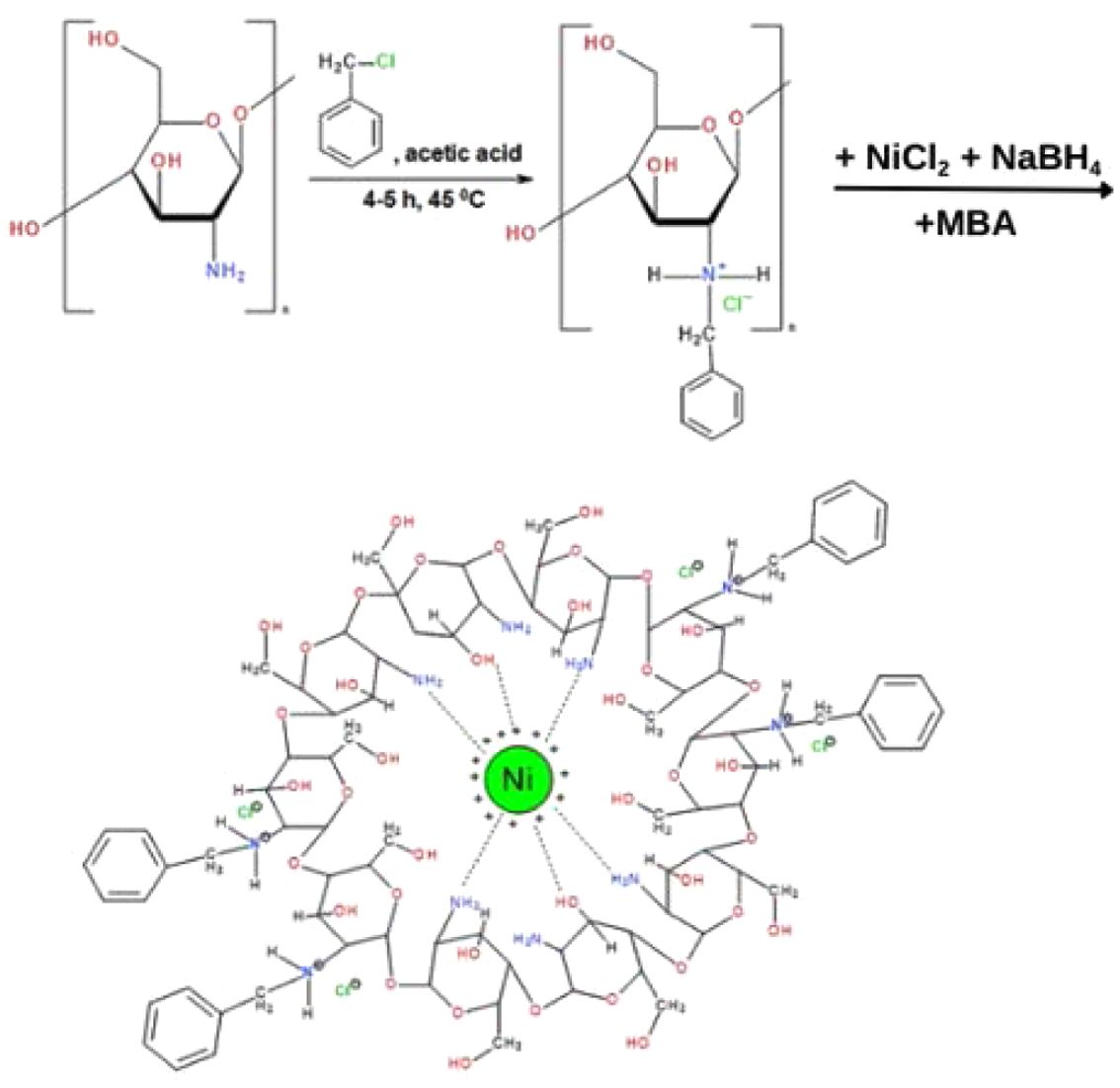
Synthesis of Benzyl Chloride–Quaternized Chitosan. Chitosan powder (1.0 g) was dissolved in 0.1 N aqueous acetic acid solution (50 mL) under continuous magnetic stirring at room temperature (25 °C) for 2 h until a homogeneous and transparent solution was obtained. Benzyl chloride (0.27 mL) was then added dropwise to the chitosan solution under vigorous stirring at 60 °C.11,19 The reaction mixture was maintained at 60 °C for 6 h. The pH was continuously monitored with a calibrated pH meter and adjusted to pH 8-9 by dropwise addition of 1 M NaOH solution to promote quaternary ammonium formation and induce precipitation of the modified polymer. Upon completion, the precipitate was filtered, washed three times with deionized water (3×50 mL) and twice with ethanol (2×30 mL). The purified product was subsequently dried under ambient conditions to obtain the final quaternized chitosan as a pale-colored powder. The yield of the quaternized product was approximately 25%. A schematic representation of the quaternization pathway is illustrated in Figure 1.
Formation of Nickel(II) Complexes. Aqueous nickel(II) chloride hexahydrate NiCl2·6H2O solution (0.1 M, 50 mL) was gradually introduced into a dispersion of benzyl chloride–quaternized chitosan (0.5 g) in deionized water (50 mL) under continuous magnetic stirring at room temperature (25 °C).20 The pH of the mixture was maintained between 4.5 and 5 using dilute NaOH solution (0.1 M) to ensure effective Ni2+ coordination while avoiding bulk Ni(OH)2 precipitation. The mixture was stirred for 12 h. The resulting nickel-loaded polymer was separated by filtration, washed with deionized water (3 × 50 mL), and dried at 50 °C for 24 h (Figure 2).21-23
Crosslinking of Nickel-Loaded Quaternized Chitosan. The nickel-loaded quaternized chitosan was dispersed in deionized water to form a homogeneous suspension, after which MBAA was added at a mass ratio of 10% relative to the polymer (0.1 g MBAA per 1.0 g polymer) under continuous stirring.26 The crosslinking reaction was conducted for 4 h, allowing covalent bridges to form between polymer chains and creating a three-dimensional network that stabilizes incorporated nickel species. After completion, the crosslinked composite was washed with deionized water (3 × 30 mL) and ethanol (2 × 20 mL) to remove unreacted crosslinker, and dried at 50 °C for 24 h. This step improves mechanical robustness and structural stability while minimizing metal leaching, without altering the fundamental coordination chemistry of the Ni2+ ions (Figure 3).27
Characterization Techniques. The structural and chemical properties of pristine chitosan, benzyl chloride–quaternized chitosan, and nickel-loaded composites were systematically investigated using XRD and FTIR spectroscopy.
Crystallinity and phase composition were analyzed using a Rigaku Miniflex 600 diffractometer equipped with Cu Kα radiation (λ = 1.54 Å). Diffractograms were recorded to monitor structural changes in the polymer after quaternization and to detect any Ni-related crystalline features.
Spectroscopic analysis was performed with a Nicolet iS10 FTIR spectrometer in the 4000–400 cm-1 range. FTIR was employed to confirm successful benzyl quaternization and to identify characteristic spectral shifts corresponding to coordination interactions between Ni2+ ions and the functional groups of chitosan. Particular attention was paid to aromatic signals introduced by benzyl modification, as well as to shifts in NH2, OH, and other functional group bands indicative of metal binding.

|
Figure 1 Schematic illustration of the quaternization of chitosan with benzyl chloride. |

|
Figure 2 roposed coordination model illustrating the interaction of Ni2+ ions with benzyl chloride–quaternized chitosan through amino, hydroxyl, and quaternary ammonium functionalities, forming a structurally stabilized polymer–metal complex (adapted and modified from Refs. 24 and 25). |

|
Figure 3 Schematic illustration of the formation of quaternized chitosan-nickel complex. |
The structural evolution of chitosan during benzyl chloride quaternization and subsequent nickel(II) incorporation was systematically investigated using XRD (Figure 4) and FTIR (Figure 5) spectroscopy. Pristine chitosan exhibited two characteristic reflections at 2θ » 10° and 20°, corresponding to the (020) and (110) planes, respectively,28-32 indicative of its semicrystalline structure wherein ordered crystalline domains coexist with amorphous regions stabilized by extensive hydrogen bonding among hydroxyl and amino functionalities. Following quaternization, these reflections became broader and less intense, indicating partial disruption of the original hydrogen-bonding network and reduced crystallinity due to the introduction of bulky benzyl quaternary ammonium groups. This structural reorganization enhances the accessibility of functional groups, preparing the polymer matrix for effective metal coordination.33-37 Upon immobilization of Ni2+ ions, additional broad diffraction features appeared around 2θ » 37° and 44°, consistent with highly dispersed nickel species, including weakly crystalline Ni(OH)2, residual NiCl2, or molecularly coordinated nickel complexes. The broad and low-intensity nature of these peaks indicates that Ni2+ ions are predominantly present as highly dispersed molecular complexes or small clusters rather than as bulk crystalline aggregates, which is advantageous for applications requiring high surface area and uniform metal distribution (Table 1).
FTIR spectroscopy further confirmed the successful chemical modification and metal incorporation. The pristine chitosan spectrum displayed characteristic bands at ~3446 cm-1 (O–H/N–H stretching), 2920 cm-1 (C–H stretching), 1646 cm-1 (amide I, C=O stretching), and 1579 cm-1 (N–H bending), corresponding to native functional groups available for coordination.38 Following quaternization, new bands emerged at 3000–3080 cm-1 (aromatic C–H) and 1642 cm-1 (C–N⁺ stretching), confirming the formation of benzyl quaternary ammonium groups, while alterations in the broad O–H/N–H region indicate disruption of hydrogen bonding.11-19 Subsequent nickel incorporation led to further spectral shifts, including modifications of the O–H stretching region above 3000 cm-1, CH2 vibrations at 2891 cm-1, C–C at 1399 cm-1, and C–O at 1024 cm-1, consistent with coordination of Ni2+ ions through residual amino groups and hydroxyl groups. Although quaternary ammonium centers do not possess a donor lone pair and therefore do not directly participate in metal coordination, they contribute indirectly by enhancing polymer chain flexibility and improving the accessibility of genuine donor sites (Table 2).39,40 These combined XRD and FTIR results demonstrate that benzyl chloride–quaternized chitosan undergoes substantial structural reorganization, generating a favorable coordination environment for nickel complex formation, with nanoscale dispersion of metal species that is likely to enhance future catalytic and adsorption performance without the need to claim any application in this study.

|
Figure 4 X-ray diffraction patterns of (a) pure chitosan; (b) nickel-loaded benzyl chloride-quaternized chitosan composite. |

|
Figure 5 FTIR spectra of (a) pure chitosan; (b) quaternized chitosan; (c) Ni-loaded chitosan nanocomposite. |
|
Table 1 XRD Peak Positions and Structural Assignments for Pristine Chitosan, Benzyl Chloride–quaternized Chitosan, and Nickel-loaded Composites |

|
Table 2 FTIR Spectral Bands and Assignments Indicating Chemical Modifications During Quaternization and Coordination of Ni2+ Ions with Chitosan |

This study demonstrates the successful synthesis of benzyl chloride–quaternized chitosan and its effective utilization as a functional support for nickel(II) complex formation. Quaternization of the primary amine groups introduced benzyl quaternary ammonium functionalities, imparting permanent positive charges, enhancing aqueous solubility, and generating a more flexible, accessible polymer structure conducive to metal coordination. Structural characterization confirmed these modifications: XRD analysis revealed a marked reduction in the crystallinity of native chitosan and the emergence of new diffraction features upon nickel incorporation, indicating successful immobilization of dispersed nickel species. FTIR spectroscopy corroborated the formation of benzyl quaternary ammonium groups and provided clear evidence of coordination interactions involving hydroxyl, amino, and quaternary nitrogen sites with Ni²⁺ ions. Together, these results establish benzyl chloride–quaternized chitosan as a structurally favorable biopolymeric platform for stabilizing nanoscale nickel species. The enhanced accessibility of functional groups and metal-binding capacity highlight the promise of this material as a versatile support for future catalytic or adsorption applications. Further studies may focus on exploring the influence of quaternization degree and metal loading on stability and performance, as well as extending this modification strategy to other transition metals to broaden the applicability of quaternized chitosan as a sustainable and multifunctional support material.
- 1. Alves, N. M.; Mano, J. F. Chitosan Derivatives Obtained by Chemical Modifications for Biomedical and Environmental Applications. Int. J. Biological Macromol. 2008, 43, 401-414.
-

- 2. Ji, J.; Hao, S.; Wu, D.; Huang, R.; Xu, Y. Preparation, Characterization and In Vitro Release of Chitosan Nanoparticles Loaded with Gentamicin and Salicylic Acid. Carbohydrate Polym. 2011, 85, 803-808.
-
- 3. Sahariah, P.; Másson, M. Antimicrobial Chitosan and Chitosan Derivatives: A Review of the Structure-activity Relationship. Biomacromolecules 2017, 18, 3846-3868.
-
- 4. Aranaz, I.; Alcántara, A. R.; Civera, M. C.; Arias, C.; Elorza, B.; Heras Caballero, A.; Acosta, N. Chitosan: An Overview of Its Properties and Applications. Polymers 2021, 13, 3256.
-
- 5. Crini, G.; Badot, P.-M. Application of Chitosan, a Natural Aminopolysaccharide, for Dye Removal from Aqueous Solutions by Adsorption Processes Using Batch Studies: A Review of Recent Literature. Prog. Polym. Sci. 2008, 33, 399-447.
-
- 6. Kumar, M. N. V. R.; Muzzarelli, R. A. A.; Muzzarelli, C.; Sashiwa, H.; Domb, A. J. Chitosan Chemistry and Pharmaceutical Perspectives. Chem. Rev. 2004, 104, 6017-6084.
-
- 7. Rinaudo, M. Chitin and Chitosan: Properties and Applications. Prog. Polym. Sci. 2006, 31, 603-632.
-
- 8. Chen, Q.; Xiao, S.; Shi, S.; Cai, L. Synthesis, Characterization, and Antibacterial Activity of N-substituted Quaternized Chitosan and Its Cellulose-based Composite Film. BioResources, 2020, 15, 415-428.
-
- 9. Mourya, V. K.; Inamdar, N. N. Chitosan-modifications and Applications: Opportunities Galore. Reactive and Functional Polym. 2008, 68, 1013-1051.
-
- 10. Omidi, S.; Kakanejadifard, A. An Overview of Current Knowledge on the Properties, Synthesis and Applications of Quaternary Chitosan Derivatives. Polymers 2020, 12, 2989.
-
- 11. Aslanova, H. F.; Seidova, C. M.; Jabieva, S. A.; Shikhverdieva, N. T.; Zeynalov, N. A.; Tagiyev, D. B. Quaternization of Chitosan in Different Media and Immobilization of Drugs on Quaternized Chitosan. Azerbaijan Chem. J. 2024, 2024, 5-17.
-
- 12. Kujur, J. P.; Moon, P. R.; Pathak, D. D. Surface Modification of Chitosan with Ni(II) Schiff Base Complex: A New Heterogeneous Catalyst for the Synthesis of Xanthones. Int. J. Biolog. Macromol. 2023, 252, 126497.
-
- 13. Zhang, J. S.; Zhang, W. D. Nickel Complex Co-catalyst Confined by Chitosan Onto Graphitic Carbon Nitride for Efficient H2 Evolution. J. Colloid Interface Sci. 2020, 560, 11-20.
-
- 14. Alamro, F. S.; Hefnawy, M. A.; Nafee, S. S.; Al-Kadhi, N. S.; Pashameah, R. A.; Ahmed, H. A.; Medany, S. S. Chitosan Supports Boosting NiCo2O4 for Catalyzed Urea Electrochemical Removal Application. Polymers 2023, 15, 3058.
-
- 15. Kamal, T.; Khan, S. B.; Asiri, A. M. Nickel Nanoparticles-chitosan Composite Coated Cellulose Filter Paper: An Efficient and Easily Recoverable Dip-catalyst for Pollutants Degradation. Environmental Pollution, 2016, 218, 625-633.
-
- 16. El-Nagar, G. A.; Derr, I.; Fetyan, A.; Roth, C. One-pot Synthesis of a High Performance Chitosan-nickel Oxyhydroxide Nanocomposite for Glucose Fuel Cell and Electro-sensing Applications. Appl. Catalysis B: Environmental 2017, 204, 185-199.
-
- 17. Shikhverdieva, N. T.; Mammedova, U. A.; Zeynalov, N. A. The Scientific Basis of the Industrial Application of the Process of Selective Hydrogenation of Benzene in Different Catalytic Systems. Azerbaijan Chem. J., 2023, 2024, 39-52.
-
- 18. Parsafard, N.; Peyrovi, M. H.; Abdali Hajiabadi, M. Nickel Hydrogenation Composite Catalysts Modified by Zirconium in Competitive Benzene Hydrogenation: Effect of Modifiers. Phys. Chem. Res. 2020, 8,203-213.
-
- 19. Zeynalov, N.; Mammadova, U.; Mammadova, S.; Rajabli, A.; Rahimli, N.; Aslanova, H.; Seidova, C. Quartization of Chitosan with Benzyl Chloride and Study of Its Structure by Physical Method. In Proceedings of the 5th International Scientific and Practical Conference, Global and Regional Aspects of Sustainable Development, Copenhagen, Denmark, October 25-26, 2021, 82.
-
- 20. Wujcicki, L.; Ma´n dok, T.; Paprota, D.; Piotrowski, K.; Adamek, J.; Krzywiecki, M.; Kluczka, J. Nickel(II)-modified Chitosan Hydrogel: A Hybrid Sorbent for Removal of Phosphate Anions from Water. Int. J. Biological Macromol. 2025, 146994.
-
- 21. Hadi, A. G. Adsorption of Nickel Ions by Synthesized Chitosan. Adsorption, 2012, 6, 109-113.
- 22. Ahmad, H.; Reduan, S. A.; Yusoff, N. Chitosan Capped Nickel Oxide Nanoparticles as a Saturable Absorber in a Tunable Passively Q-Switched Erbium Doped Fiber Laser. RSC Advances, 2018, 8, 25592-25601.
-
- 23. Krajewska, B. Diffusion of Metal Ions Through Gel Chitosan Membranes. Reactive and Functional Polym. 2001, 47, 37-47.
-
- 24. Borandeh, S.; Laurén, I.; Teotia, A.; Niskanen, J.; Seppälä, J. Dual Functional Quaternary Chitosans with Thermoresponsive Behavior: Structure–activity Relationships in Antibacterial Activity and Biocompatibility. J. Mater. Chem. B, 2023, 11, 11300-11309.
-
- 25. Sirajunnisa, P.; Sabna, C.; Aswin, A.; Prathapan, S.; Sailaja, G. S. Lawsone-bentonite Hybrid Systems for pH-dependent Sustained Release of Ciprofloxacin. New J. Chem. 2022, 46, 9560-9571.
-
- 26. Mammadova, S. M.; Guliyeva, C. E.; Racabli, A. R.; Aslanova, H. F.; Shikhverdiyeva, N. T.; Rahimli, N. T.; Zeynalov, N. A. Obtaining a Hydrogel Based on Chitosan, Study Its Structure and Sorbtion Ability with Levofloxacin Antibiotics. Chemical Prob. 2021, 4, 215-223.
-
- 27. Gonsalves, A. D. A.; Araújo, C. R. M.; Soares, N. A.; Goulart, M. O. F.; Abreu, F. C. D. Different Strategies for Crosslinking of Chitosan. Química Nova, 2011, 34, 1215-1223.
-
- 28. Guibal, E. Interactions of Metal Ions with Chitosan-based Sorbents: a Review. Separation and Purification Technol. 2004, 38, 43-74.
-
- 29. Marei, N. H.; Abd El-Samie, E.; Salah, T.; Saad, G. R.; Elwahy, A. H. Isolation and Characterization of Chitosan From Different Local Insects in Egypt. Int. J. Biological Macromol. 2016, 82, 871-877.
-
- 30. Osorio-Madrazo, A.; David, L.; Trombotto, S.; Lucas, J. M.; Peniche-Covas, C.; Domard, A. Kinetics Study of the Solid-state Acid Hydrolysis of Chitosan: Evolution of the Crystallinity and Macromolecular Structure. Biomacromolecules, 2010, 11, 1376-1386.
-
- 31. Brunel, F.; Véron, L.; Ladaviere, C.; David, L.; Domard, A.; Delair, T. Synthesis and Structural Characterization of Chitosan Nanogels. Langmuir, 2009, 25, 8935-8943.
-
- 32. Baklagina, Y. G.; Klechkovskaya, V. V.; Kononova, S. V.; Petrova, V. A.; Poshina, D. N.; Orekhov, A. S.; Skorik, Y. A. Polymorphic Modifications of Chitosan. Crystallography Reports, 2018, 63, 303-313.
-
- 33. Zhang, Y.; Xue, C.; Xue, Y.; Gao, R.; Zhang, X. Determination of the Degree of Deacetylation of Chitin and Chitosan by X-ray Powder Diffraction. Carbohydrate Research, 2005, 340, 1914-1917.
-
- 34. Agnes, J.; Selvakumar, M. S.; Anand, D. P. Synthesis and Characterization of Chitosan Encapsulated Nickel Oxide Nanoparticles Modified with Folic Acid. Mater. Today: Proceedings, 2022, 66, 1658-1663.
-
- 35. Ali, H.; Tiama, T. M.; Ismail, A. M. New and Efficient NiO/chitosan/polyvinyl Alcohol Nanocomposites as Antibacterial and Dye Adsorptive Films. Int. J. Biological. Macromol. 2021, 186, 278-288.
-
- 36. Ramesh, T. N. X-ray Diffraction Studies on the Thermal Decomposition Mechanism of Nickel Hydroxide. J. Phys. Chem. B, 2009, 113, 13014-13017.
-
- 37. Li, C.; Liu, S. Preparation and Characterization of Ni (OH)2 and NiO Mesoporous Nanosheets. J. Nanomaterials, 2012, 2012, 648012.
-
- 38. Medany, S. S.; Nafady, A.; Soomro, R. A.; Hefnawy, M. A. Construction of Chitosan-supported Nickel Cobaltite Composite for Efficient Electrochemical Capacitor and Water-splitting Applications. Scientific Reports, 2024, 14, 2453.
-
- 39. Gang Chen; Jie Mi; Xiaohou Wu; ChunLi Luo; JiaBing Li; YaXiong Tang; Jie Li. Structural features and bioactivities of the chitosan. Int. J. Biol. Macromol. 2011, 49, 543-547.
-
- 40. Jaji, N.; Othman, M.; Lee, H.; Hussin, M.; Hui, D. One-pot Solvothermal Synthesis and Characterization of Highly Stable Nickel Nanoparticles. Nanotechnology Reviews, 2021, 10, 318-329.
-

- Polymer(Korea) 폴리머
- Frequency : Bimonthly(odd)
ISSN 2234-8077(Online)
Abbr. Polym. Korea - 2025 Impact Factor : 1.0
- Indexed in SCIE
 This Article
-
2026; 50(3): 486-492
Published online May 25, 2026
- 10.7317/pk.2026.50.3.486
- Received on Feb 13, 2026
- Revised on Mar 10, 2026
- Accepted on Mar 20, 2026
Services
- Full Text PDF
- Abstract
- ToC
- Conflict of Interest
Introduction
Experimental
Results and Discussion
Conclusion
- References
Shared
Correspondence to
- Nigar Shikhverdiyeva
-
Laboratory of Nanostructured metal-polymer catalysts, Ministry of Science and Education, Republic of Azerbaijan, Institute of Chemistry, 113 H. Javid Street, Baku AZ1143, Azerbaijan Republic
- E-mail: nigar.shikverdiyeva@kqki.science.az
- ORCID:
0009-0007-6863-9715
 Copyright(c) The Polymer Society of Korea. All right reserved.
Hyecheon Building(Room 601), #354, Gangnam-Daero, Gangnam-Gu, Seoul 06242, Korea
TEL : 82-2-568-3860, 561-5203, 569-3860 FAX : 82-2553-6938 E-mail: polymer@polymer.or.kr