








- Adhesive Properties and Biocompatibility of Dental Composites Reinforced with Cyanoacrylate and Resonance-stabilized Anions
Jin Ik Lim†

Department of Chemical Engineering, College of Engineering, Dankook University, Jukjeon-dong, Yongin-si, Gyeonggi-do 16890, Korea
- 시아노아크릴레이트와 공명 안정화 음이온으로 구성된 치과용 복합재의 접착 특성과 생체 적합성
임진익†
단국대학교 화학공학과
Reproduction, stored in a retrieval system, or transmitted in any form of any part of this publication is permitted only by written permission from the Polymer Society of Korea.
Dental composites, including glass ionomer cement (GIC), have been successfully used in dentistry. However, they have mainly been used for teeth under weak loads or in areas requiring aesthetic factors because of their low bonding strength, polymerization shrinkage, and low biocompatibility. In this study, carbonate anions were applied to ethyl 2-cyanoacrylate (EC) to improve the physical properties of the composite, and the strength, curing time, and setting time were tested according to different concentrations. Furthermore, the shear bonding strength was measured against that of dentin, and biocompatibility was determined based on the viability of fibroblasts. The optimum concentration of sodium bicarbonate (SBC) in cyanoacrylate was 11 mol%, and its compressive strength was approximately 1.3 times that of pure EC. Furthermore, EC–SBC showed higher biocompatibility and 1.4 times higher bonding strength than GIC. Therefore, EC–SBC can be widely used in dental adhesive restorations.
글라스 아이오노머 시멘트(GIC)를 비롯한 치과용 복합재는 치과 분야에서 널리 사용되고 있습니다. 그럼에도 불구하고 낮은 결합력, 중합 수축, 재료의 생체 적합성이 상대적으로 낮아 하중이 낮게 걸리는 치아 부분 또는 미적 요소가 필요한 치아에 주로 사용되어 왔습니다. 본 연구에서는 복합재의 물성을 향상시키기 위해 탄산 음이온을 에틸 2-시아노아크릴레이트(EC)에 적용하고, 이들 농도에 따른 결합 강도, 경화 시간, 가동 시간에 대해 테스트했습니다. 또한 상아질에 대한 전단 결합 강도를 측정하고 섬유아세포의 생존력에 따라 생체 적합성을 결정했습니다. 시아노아크릴레이트 내 중탄산나트륨(SBC)의 최적 농도는 11 mol% 였으며 압축 강도는 순수 EC에 비해 약 1.3배 높았습니다. 또한 EC-SBC는 GIC에 비해 1.4배 높은 결합 강도를 나타냈으며 좋은 생체 적합성을 보였습니다. 따라서 EC-SBC 소재는 치과용 접착제 및 치아 복원용 접착제 분야에 널리 적용될 수 있습니다.
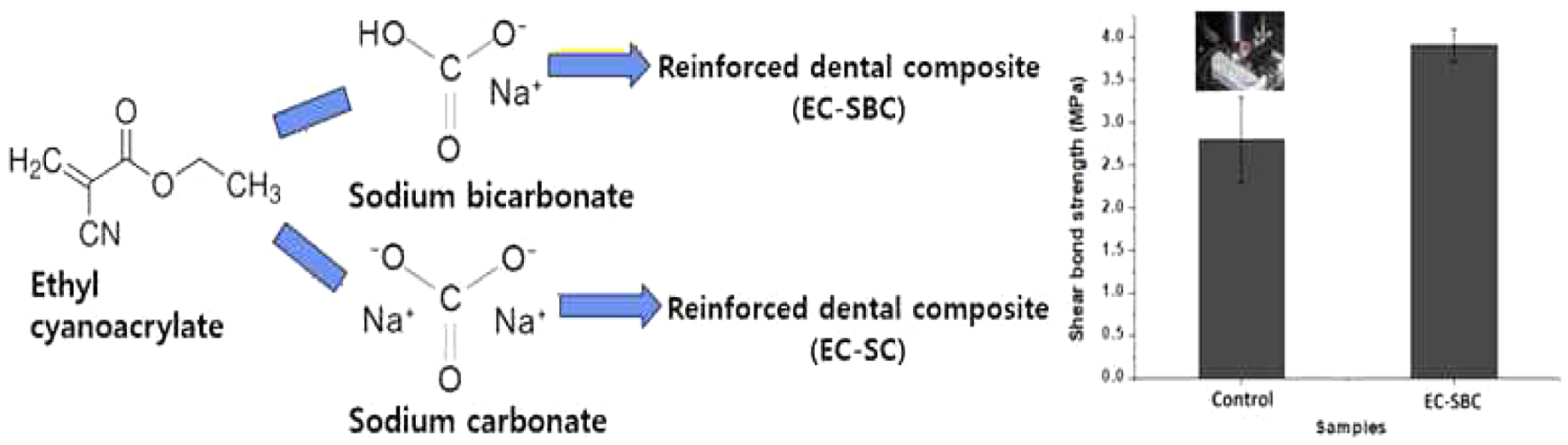
Cyanoacrylate, resonance-stabilized anions, and acetone were added to prepare an improved EC-SBC composite with high binding strength to dentin.
Keywords: cyanoacrylate, sodium bicarbonate, reinforced composite, dental composite, bioglue.
The author(s) declared no potential conflicts of interest with respect to the research, authorship, and/or publication of this article.
Dental composite resins simultaneously satisfy both dental function and aesthetics and are currently the most widely used materials in dentistry. These composites are leading aesthetic repair materials that have led to innovation in dental materials since the mid-20th century. This innovation began to develop in earnest with the introduction of bisphenol A-glycidyl methacrylate (Bis-GMA) in 1962.1,2
The advantage of resin filling is that it can be performed in a day and is relatively inexpensive. However, composite resin filling can easily fall or break, the boundary between the filling area and teeth can easily be discolored, and aesthetics can be degraded slightly. In addition, if the cavity or damage is large, it can be difficult to apply the resin.3,4
Dental composites are generally classified as organic or inorganic resins. Organic resins are mainly composed of polyfunctional methacrylate monomers, such as Bis-GMA and urethane dimethacrylate (UDMA), which form a rigid polymer network through the polymerization (curing) process and form the basic framework for composites. Although Bis-GMA has the disadvantages of high viscosity and high hygroscopicity, it is not volatile and is widely used owing to its high stability. UDMA has the advantages of low polymerization shrinkage and low viscosity compared with Bis-GMA.5,6 For inorganic resins, silica (glass particle form), barium glass, and alumina are used as fillers with acrylic acid solution as the main component of glass ionomer cement (GIC). The filler mechanically strengthens the resin substrate, reduces shrinkage during polymerization, and improves aesthetics.7,8
However, organic resins can elute unreacted monomers as the reaction progresses, and nonuniform polymerization decreases adhesion and strength depending on the size of the filler. Therefore, GIC was selected as the control material in this study. Despite its aesthetic advantages, its use in the molar region is restricted by its physical durability.9,10
Photopolymerized GIC resins are available for improving adhesion and strength, but they are only applied to filled tooth surfaces owing to the limited depth of UV transmission.11-13
To overcome these shortcomings, in this study, cyanoacrylate was selected as the main component of the resin to increase the strength of adhesion to the tooth surface because it shows very fast adhesion to various surfaces under humid conditions. Cyanoacrylate has been used in various fields to enhance the binding strength of skin adhesives, pulp-capping materials, and cavity varnishes, owing to its good biocompatibility and rapid polymerization reaction.14-16 It has also been used for the bonding of fractured teeth and the adhesion of pins to maintain amalgam restoration. The adhesion between dentin and ethyl 2-cyanoacrylate (EC) is stable after one week of water exposure, and when EC is used as a binding material, dental resin composites are maintained for 18 months.17-19 Furthermore, cyanoacrylate-based dental cements that can replace GIC and GIC with modified EC improve monomer conversion and hardness over other dental cements.18
The main advantage of a resonance-stabilized base is that the electrons are evenly dispersed throughout the molecule, thereby stabilizing the negative charge. This contributes to an improvement in the chemical reaction of the molecule as a whole. Cyanoacrylate reacts with a carbonate anion as a resonance-stabilized anion, causing anionic polymerization and quick hardening. This reaction is one of the main operating principles of instantaneous adhesives, and the carbonate-based anion contained in sodium bicarbonate (SBC) acts as a nucleophile to initiate the polymerization of the cyanoacrylate monomers. When these anions react with the cyanoacrylate molecules to form active ions, they begin to react in chains with other cyanoacrylate monomers. Through this chain reaction, the cyanoacrylate monomers form long and strong polymer chains (polymers), and the liquid adhesives quickly harden into solids.20,21
The polymerization of cyanoacrylate occurs only with weak bases, such as water, but when reacting with carbonate anions, the curing speed rapidly increases, and the adhesive strength increases. This is because carbonate anions act as strong catalysts to initiate the anionic polymerization of cyanoacrylate.
Thus, the objectives of this study were i) to design an enhanced dental composite using cyanoacrylate and carbonate anions, ii) to determine the optimal concentrations of the additives that improve the bond strength to dentin, and iii) to evaluate biocompatibility using NIH/3T3 cells.
Materials and Methods. Chemical Reagents: A commercial GIC (GC Fuji II, GC, Tokyo, Japan; Lot no. 0904081) was used as a control in this study. EC, SBC, sodium carbonate (SC), cell culture reagents, acetone, and other chemicals were purchased from Sigma-Aldrich (St. Louis, MO, USA) and used without further purification.
Preparation of Experimental EC–carbonate Anion Composites: To prepare the EC–carbonate anion composites, SBC and SC at various concentrations were dispersed in 1 g of EC, as shown in Table 1. Immediately after dispersion, the temperature change over time, polymerization time, and setting time were measured.
Temperature Change According to Reaction Time of EC–carbonate Anions: To determine the temperature change of EC–carbonate anions, the ingredients were mixed according to the compositions in Table 1, following the methods in Section 2.2. The temperature change was recorded in real time from 0 to 300 s while the carbonate anions were dispersed using a probe thermometer (TPI 367 K-type, Coretech, Gyeonggi-do, Republic of Korea).
Curing Time and Setting Time of EC–carbonate Anion Composites: The curing time was measured as the time required for the EC and carbonate anions to mix, and the entire mixed solution was completely polymerized to form a nonstick and rigid solid. The setting time was defined as the time when there is fluidity owing to partial polymerization, but molding is difficult. To determine the setting times of the EC–carbonate anions, the ingredients were mixed according to the compositions listed in Table 1. The viscosity change was measured in the small oscillation mode (1 Hz) on a rheometer (CVO 100, Bohlin Instruments, Worcestershire, UK) equipped with a cone/plate tool with a 1/40 mm disk. The setting time was set to the point at which a sudden change in the loss modulus (G'') occurred, that is, when the disk suddenly stopped. Further, the setting time in the presence of acetone was determined using the composition of Sample 1 in Table 1. Accordingly, 0.084 g of SBC was added separately to 150, 300, 500, 700, and 900 µL of acetone, sufficiently dispersed using ultrasonic waves (MISONIX, XL-2000, Microson, New York, US), and then applied to 1 g of EC. Then, the setting time was measured in the same manner as before, and after completely polymerizing each sample, the compressive strength was measured as described in the section below.
Measurement of the Amount of Load Under the Same Compressive Displacement: The difference in the load under the same compressive displacement was evaluated according to the SBC and SC contents (Table 1). The test was performed using a universal testing machine (Instron 4467, Canton, MA, USA). A polymerized composite 15 mm in diameter and 10 mm in height was fabricated. The crosshead speed was set to 1 mm/min, and the load at the point where the specimen was pressed by 1 mm was determined.
Shear Bond Strength: The shear bond strength to dentin was compared with that of GIC and EC–SBC (Sample 1 in Table 1). To prepare the dentin surface, acrylic-resin-embedded, freshly extracted human molar teeth were polished with 600 grit sandpaper using a polishing machine (RotoPol-25; Struers, Ballerup, Denmark). Each composition was then mixed and filled into a Teflon mold (4 mm in diameter and 7 mm in height) placed on the polished dentin surface. After 24 h, the mold was removed. The shear bond test was performed using a universal testing machine (the upper inset in Figure 5).22,23 The crosshead speed was set to 1 mm/min, and the load at the point where the specimen was separated from the dentin was measured.
Biocompatibility: For the biocompatibility test by direct contact,24 EC–SBC specimens (Sample 1 in Table 1) were prepared using a Teflon mold (4 mm in diameter and 7 mm in height, n = 5). The mold was removed after 24 h. After sterilization with ethylene oxide gas, the specimens were fixed in 24-well plates. A medical-grade silicone adhesive (Silastic; Dow Corning, Midland, MI, USA) was used to fix the specimen at the center of the well. The fixed specimens were rinsed thrice with phosphate-buffered saline. The washed specimens were pre-wetted with cell culture medium [Dulbecco’s modification of Eagle’s medium with 10% fetal calf serum, penicillin (100 units/mL) and streptomycin (100 lg/mL) with L-glutamine (2 mM)], and maintained at 37 °C in a 5% CO2 incubator for 12 h. Then, the medium was aspirated, and a suspension of fibroblast cells (ATCC L929, Manassas, VA, USA) was added directly to each specimen in the culture plate (2 × 10⁵ cells in 500 µL/well). Culture wells without the specimens were used as controls. The relative cell viability at 4, 24, 48, and 72 h was determined and compared with that of the control using the WST-8 assay.25

|
Figure 1 Temperature change (℃) of EC–SBC composites with the amount of SBC (The composition is shown in Table 1, n = 3) |

|
Figure 2 Temperature change (℃) of EC–SC composites with the amount of SC (The composition is shown in Table 1, n = 3). |

|
Figure 3 Curing time of EC–carbonate composites according to the amount of carbonate anions (n = 5). |

|
Figure 4 Changes in setting time and compressive strength according to acetone amount (n = 5). |

|
Figure 5 Shear bond strength of GIC and Sample 1 to dentin (The top photo is a device) (n = 5). |

Temperature of EC–SBC Composites According to SBC Amount. SBC is known to cause an exothermic reaction mainly by initiating cyanoacrylate and anionic polymerization.26 This experiment was conducted to confirm its applicability to teeth by measuring the degree of heat generation according to the amount of SBC and time. As shown in Figure 1, as the amount of SBC increased, the temperature also tended to increase; the temperature rapidly increased to approximately 70 °C from 0 to 300 s and then decreased. Good physical properties and low polymerization heat are essential for application to teeth. As we applied the samples to the interface of teeth, a condition not exceeding the temperature of 50 °C in a short time was set as the optimal condition. Therefore, it was determined that Samples 1 and 2 were suitable in terms of temperature.
Temperature of EC–SC Composites According to SC Amount. SC, as a carbonate divalent anion, has a similar structure to the carbonate monovalent anion of SBC. In the case of SBC, anionic polymerization can only be performed in one place; however, in SC, it can be performed in two places. Accordingly, this experiment was conducted. As shown in Figure 2, the reaction rate was faster than that of SBC, and the temperature increased to approximately 80 °C. In addition, the rate of temperature decrease was faster than that of SBC. Unlike SBC, this is the effect of nearly doubling the amount of initiator, making it possible to predict that the initial reaction rate is fast, the polymerization heat is high, and the degree of polymerization is low. Based on this experiment, Samples 10 and 11 were selected as the optimal compositions.
Curing Time. The curing time is the time at which the reaction is completely terminated, the entire adhesive component is hardened, and there is no stickiness. Two-way analysis of variance (ANOVA) was conducted to determine the statistical significance between the two groups (SBC vs. SC). Regarding the effect of the sample number, a value of p < 0.001 was observed, indicating that the curing time changed significantly across different sample numbers and confirming that the mixing ratio is a key variable influencing the curing rate. The difference between the SC and SBC groups was also significant (p < 0.01), with the SC group exhibiting a higher average curing rate than the SBC group. Detailed explanations are as follows.
As shown in Figure 3, pure cyanoacrylate took approximately 8 h, and as the amount of SBC or SC increased, the time was significantly shortened. In addition, for Samples 1, 2, 10, and 11, both SBC and SC reacted completely within approximately 3–5 h. In the case of dental fillings, the minimum time and strength for fast adhesion to the initial tooth surface and the maintenance of shape are important. If polymerization occurs too quickly, the degree of polymerization decreases, and if the polymerization takes too long, a problem occurs. Therefore, proper setting and curing times should be harmonized, and mechanical strength and adhesion should be maintained. If complete polymerization is possible within 5 h, the sample can be applied as a dental composite.
Measurement of the Amount of Load Under the Same Compressive Displacement. The average strength across all the samples was 20.95 ± 2.68 MPa. An independent sample t-test was performed to evaluate the significance of variations based on the type and content of additives. The analysis revealed no statistically significant differences between Samples 1 and 2 (p > 0.05), or between Samples 10 and 11 (p > 0.05), as noted in the main text. This suggests that compositional changes within these specific ranges have a negligible impact on physical strength.
In contrast, a sharp decline in strength was observed for the SBC mixtures after Sample 6 and for the SC mixtures after Sample 14. A highly significant difference (p < 0.01) was confirmed when the highest-strength group (e.g., Samples 1 and 3) was compared with the lowest-strength group (e.g., Sample 18). This is attributed to the fact that, when the concentration of carbonate salts exceeds a critical threshold, these salts interfere with the network formation of cyanoacrylate during polymerization, thereby weakening the cohesive strength. Overall, the SBC-based samples maintained a higher average strength than the SC samples (p < 0.05), owing to the differences in the initiator reaction efficiency and molecular weight control. Consequently, Samples 1, 2, 10, and 11, which demonstrated both high strength and statistical stability, were selected as the optimal compositions for subsequent setting time and adhesive strength testing.
Setting Time. TheANOVA results indicated that the amount of acetone significantly influenced both the setting time (p < 0.001) and compressive strength (p < 0.001). Specifically, regarding the setting time, the rate of increase increased significantly starting from 500 µL, leading to a pronounced reaction delay. As for the compressive strength, the samples maintained relatively stable values up to 300 µL; however, a significant decline was observed beyond 500 µL, reaching the minimum value at 900 µL.
The detailed measurement results are presented in Table 3 and Figure 4. The results for Samples 1, 2, 10, and 11 were confirmed between 1 and 3 s. It was determined that this amount of time was insufficient for the molding process, and the experiment was conducted by extending the setting time. To increase the setting time, the distance between the cyanoacrylate molecules was increased. Acetone, a representative solvent, was mixed using only the composition of Sample 1, and as shown in Figure 4, SBC was first ultrasonically dispersed in 150, 300, 500, 700, and 900 µL of acetone. Consequently, in the case of 150 and 300 µL, the setting time increased to approximately 5 s, whereas the difference in strength hardly occurred. However, when a larger amount of acetone was used, a significant problem occurred in terms of strength. Therefore, the next experiment was conducted by using 300 µL of acetone in the composition of Sample 1.
Shear Bond Strength of the EC–SBC Composite. The shear bond strengths of GIC as a reference and the EC–SBC composite (Sample 1) were measured. The t-test results showed that the difference in the shear bond strength between GIC and Sample 1 was significant (p < 0.05). The measurement results for the shear bond strength are shown in Figure 5. The value for GIC was measured as 2.8 MPa, and that for EC–SBC was measured as 3.9 MPa. As EC–SBC was approximately 1.4 times stronger, it can be applied as a dental composite.
Biocompatibility. Direct contact experiments using NIH/3T3 cells were conducted to evaluate the toxicity of EC–SBC. The experimental results are shown in Figure 6. After 4 h, there appeared to be a slight difference in the degree of cell adhesion; however, the difference decreased as the cultivation time increased. This was presumed to be the result of a small number of unreacted molecules eluted from cyanoacrylate at the beginning of the cell experiment. Overall, no significant cytotoxicity was observed. As shown in the graph, there were no statistically significant differences in absorbance between the control and Sample 1 at any time point (4, 24, 48, and 72 h) (p > 0.05). Both groups exhibited a similar trend in cell proliferation over time, suggesting that Sample 1 did not significantly affect cell viability or growth under the tested conditions. This study confirmed that this sample can be applied as an adhesive and a filler to hard tissues, including teeth.

|
Figure 6 Differences in cell adhesion and proliferation with EC– SBC composite (Sample 1) and cell culture plates (control) (n = 5) |
|
Table 2 Measurement of the Amount of Load Under the Same Compressive Displacement (n = 5) |


Cyanoacrylate, SBC, and acetone were added to prepare an improved EC–SBC composite with high binding strength to dentin. To determine the optimal composition of EC–SBC, carbonate anions of various concentrations were added, and tests were conducted regarding the setting time, shear binding strength, compressive strength, curing time, temperature, and biocompatibility of EC–SBC. The composite showed higher shear binding strength to dentin than unmodified GIC. The strength-enhancing effect of SBC was confirmed, and the biocompatibility test results were similar to those of the control. However, for widespread use in the field of biomaterials, including dentistry, studies on anions and biocompatible solvents with lower temperatures and longer setting times are required.
- 1. Yoshinaga, K.; Yoshihara, K.; Yoshida, Y. Development of New Diacrylate Monomers as Substitutes for Bis-GMA and UDMA. Dent. Mater. 2021, 37, e391-e398.
-

- 2. Floyd, C. J. E.; Dickens, S. H. Network Structure of Bis-GMA- and UDMA-based Resin Systems. Dent. Mater. 2006, 22, 1143-1149.
-
- 3. Zhou, Q.; Lin, J.; Li, Q. Study of High-strength, Low-shrinkage Dental Resin Composites with Bifunctional Polysilsesquioxane. Dent. Mater. 2025, 41, 755-767.
-
- 4. Yamamoto, T.; Ferracane, J. L.; Sakaguchi, R. L.; Swain, M. V. Calculation of Contraction Stresses in Dental Composites by Analysis of Crack Propagation in the Matrix Surrounding A Cavity. Dent. Mater. 2009, 25, 543-550.
-
- 5. Barszczewska-Rybarek, I. M. Structure–property Relationships in Dimethacrylate Networks Based on Bis-GMA, UDMA and TEGDMA. Dent. Mater. 2009, 25, 1082-1089.
-
- 6. Lin, C. H.; Lin, Y. M.; Lai, Y. L.; Lee, S. Y. Mechanical Properties, Accuracy, and Cytotoxicity of UV-polymerized 3D Printing Resins Composed of Bis-EMA, UDMA, and TEGDMA. J. Prosthet. Dent. 2020, 123, 349-354.
-
- 7. Ansari, S.; Moshaverinia, M.; Roohpour, N.; Chee, W. W. L.; Schricker, S.R.; Moshaverinia, A. Properties of a Proline-containing Glass Ionomer Dental Cement. J. Prosthet. Dent. 2013, 110, 408-413.
-
- 8. McKenzie, M. A.; Linden, R. W. A.; Nicholson, J. W. The Physical Properties of Conventional and Resin-modified Glass-ionomer Dental Cements Stored in Saliva, Proprietary Acidic Beverages, Saline and Water. Biomater. 2003, 24, 4063-4069.
-
- 9. Wang, X.; Huyang, G.; Palagummi, S. V.; Liu, X.; Skrtic, D.; Beauchamp, C.; Bowen, R.; Sun, J. High Performance Dental Resin Composites with Hydrolytically Stable Monomers. Dent. Mater. 2018, 34, 228-237.
-
- 10. Cebe, M. A.; Cebe, F.; Cengiz, M. F.; Cetin, A. R.; Arpag, O. F.; Ozturk, B. Elution of Monomer from Different Bulk Fill Dental Composite Resins. Dent. Mater. 2015, 31, e141-e149.
-
- 11. Dursun, E.; Nguyen, J. F.; Tang, M. L.; Attal, J. P.; Sadoun, M. HEMA Release and Degree of Conversion From a Resin-modified Glass Ionomer Cement after Various Delays of Light Activation. Dent. Mater. 2016, 32, 640-645.
-
- 12. Abbasi, R.; Nodehi, A.; Atai, M. Synthesis of Poly(acrylic-co-itaconic acid) Through Precipitation Photopolymerization for Glass-ionomer Cements: Characterization and Properties of the Cements. Dent. Mater. 2020, 36, e169-e183.
-
- 13. Swift, E. J.; Pawlus, M. A.; Vargas, M. A.; Fortin, D. Depth of Cure of Resin-modified Glass Ionomers. Dent. Mater. 1995, 11, 196-200.
-
- 14. Lim, J. I.; Kim, J. H. Enhanced Biocompatibility and Adhesive Properties of Modified Allyl 2-cyanoacrylate-based Elastic Bio-glues. Colloids Surf., B 2015, 133, 19-23.
-
- 15. Lim, J. I.; Lee, W. K. Enhanced Biocompatibility and Adhesive Properties by Aromatic Amino Acid-modified Allyl 2-cyanoacrylate-based Bio-glue. Colloids Surf., B 2014, 122, 669-673.
-
- 16. Athavale, A.; Thao, M.; Sassaki, V. S.; Lewis, M.; Chandra, V.; Fukaya, E. Cyanoacrylate Glue Reactions: A Systematic Review, Cases, and Proposed Mechanisms. J. Vasc. Surg: Venous Lymphat. Disord. 2023, 11, 876-888.e1.
-
- 17. Tomlinson, S. K.; Ghita, O. R.; Hooper, R. M.; Evans, K. E. Monomer Conversion and Hardness of Novel Dental Cements Based on Ethyl Cyanoacrylate. Dent. Mater. 2007, 23, 799-806.
-
- 18. Lim, J. I.; Lim, K. J.; Lim, H. N.; Lee, Y. K. Bond Strength of Experimental Cyanoacrylate-Modified Dentalglass Ionomer Cements. J. Mater. Sci. 2010, 45, 5211-5217.
-
- 19. Borie, E.; Rosas, E.; Kuramochi, G.; Etcheberry, S.; Olate, S.; Weber, B. Oral Applications of Cyanoacrylate Adhesives: A Literature Review Biomed. Res. Int. 2019, 17, 8217602.
-
- 20. Wang, H.; Gao, H.; Yang, H.; Zhang, H.; Zhao, X. Synthesis and Evaluation of Ethyl α-cyanoacrylate-based Composites with Alkaline Solid Waste Additives as Initiators for Structural Repair. Constr. Build. Mater. 2026, 507, 145092.
-
- 21. P, S.; Shivanand, H. K.; Debey, H. C.; Amjed, R.; R, M. Investigation on Mechanical Properties of Cyanoacrylate and Sodium Bicarbonate Reinforced Polymer Matrix Composite. Int. J. Innov. Sci. Eng. Technol. 2024, 11, 6-14.
- 22. Fawzy, A. S.; El-Askary, F. S.; Amer, M. A. Effect of Surface Treatments on the Tensile Bond Strength of Repaired Water-aged Anterior Restorative Micro-fine Hybrid Resin Composite. J. Dent. 2008, 36, 969-976.
-
- 23. International Organization for Standardization. Dental Materials - Testing of Bond Strength to Tooth Structure; ISO/TS 11405:2003; Geneva, Switzerland, 2003.
- 24. de Souza Costa, C. A.; Hebling, J.; Garcia-Godoy, F.; Hanks, C. T. In Vitro Cytotoxicity of Five Glass-ionomer Cements. Biomater. 2003, 24, 3853-3858.
-
- 25. Präbst, K., Engelhardt, H., Ringgeler, S., Hübner, H. Basic Colorimetric Proliferation Assays: MTT, WST, and Resazurin. In Cell Viability Assays; Gilbert, D., Friedrich, O., Eds.; Methods in Molecular Biology, Vol. 1601; Humana Press: New York, 2017, pp 1-17.
-
- 26. García-Tamayo, M.; González-Martínez, J. G.; García-Huerta, M. A.; Campos-Jiménez, M.; Márquez-Rocha, M. L. Osteosynthesis with 2-octylcyanoacrylate and Sodium Bicarbonate in Zygomatic Arch Fractures: Animal Model Results. Rev. Med. Inst. Mex. Seguro Soc. 2011, 49, 605-610.

- Polymer(Korea) 폴리머
- Frequency : Bimonthly(odd)
ISSN 2234-8077(Online)
Abbr. Polym. Korea - 2025 Impact Factor : 1.0
- Indexed in SCIE
 This Article
-
2026; 50(4): 581-587
Published online Jul 25, 2026
- 10.7317/pk.2026.50.4.581
- Received on Mar 16, 2026
- Revised on May 5, 2026
- Accepted on May 18, 2026
Services
- Full Text PDF
- Abstract
- ToC
- Conflict of Interest
Introduction
Experimental
Results and Discussion
Conclusions
- References
Shared
Correspondence to
- Jin Ik Lim
-
Department of Chemical Engineering, College of Engineering, Dankook University, Jukjeon-dong, Yongin-si, Gyeonggi-do 16890, Korea
- E-mail: limjinik@dankook.ac.kr
- ORCID:
0000-0003-4803-0455
 Copyright(c) The Polymer Society of Korea. All right reserved.
Hyecheon Building(Room 601), #354, Gangnam-Daero, Gangnam-Gu, Seoul 06242, Korea
TEL : 82-2-568-3860, 561-5203, 569-3860 FAX : 82-2553-6938 E-mail: polymer@polymer.or.kr